Appetite for Blood: The World of Sanguivores
Blood has fascinated humans for thousands of years. It has been associated with life, death, vitality, sacrifice, and the supernatural. But while vampires have largely remained creatures of folklore, the natural world is full of genuine blood-feeders. Known as sanguivores, these animals have evolved some extraordinary ways of sustaining themselves.
The word sanguivore comes from the Latin sanguis, meaning blood, and vorus, meaning to devour. Its related adjective, sanguivorous, describes an animal that feeds on blood. Another commonly used scientific term is hematophagy, derived from the Greek haima (blood) and phagein (to eat). Humans have been aware of blood-feeding animals for millennia. Leeches, for example, were used in ancient medicine, with historical records documenting their application for bloodletting as far back as 1500 BCE in ancient Egypt. Their popularity increased in nineteenth-century Europe, when millions were collected for medical treatments. Physicians believed removing blood could restore the body’s balance and cure numerous ailments.
In Caribbean traditions, particularly in Trinidad and parts of the Eastern Caribbean, stories tell of the Soucouyant, a supernatural figure often depicted as an older woman who sheds her skin at night and transforms into a ball of fire. She is said to enter homes through small openings and feed on the blood of sleeping inhabitants. In some accounts, victims develop unexplained marks or become progressively weakened.
In the natural world, blood-feeding is the cause of biological adaptation that has evolved in animals with very different anatomies and lifestyles. Some species have developed specialized mouthparts for piercing skin, while others exploit existing wounds or have formed highly specialized relationships with their hosts. Take the tongue-eating louse, this marine crustacean enters a fish’s mouth through its gills and attaches itself to the tongue, gradually cutting off its blood supply until the tongue withers away. The parasite then stays in its place, effectively acting as a replacement tongue while feeding on blood and mucus.
On the Galápagos Islands, the vampire finch feeds on the blood of seabirds, particularly Nazca and red-footed boobies. When food becomes scarce, the finches peck at the skin around the birds’ feathers until blood begins to flow. This behavior is thought to have developed from an earlier relationship in which the finches picked parasites off the seabirds.
Some blood-feeders have developed specialized body parts to help them feed. The giant Amazonian leech, which can grow to 12–18 inches long, has an extendable feeding tube that it uses to pierce its host’s skin and reach the blood beneath. Its saliva contains substances that stop blood from clotting, allowing it to continue feeding. One of these substances, called hementin, has attracted scientific interest because of its potential uses in medical research.
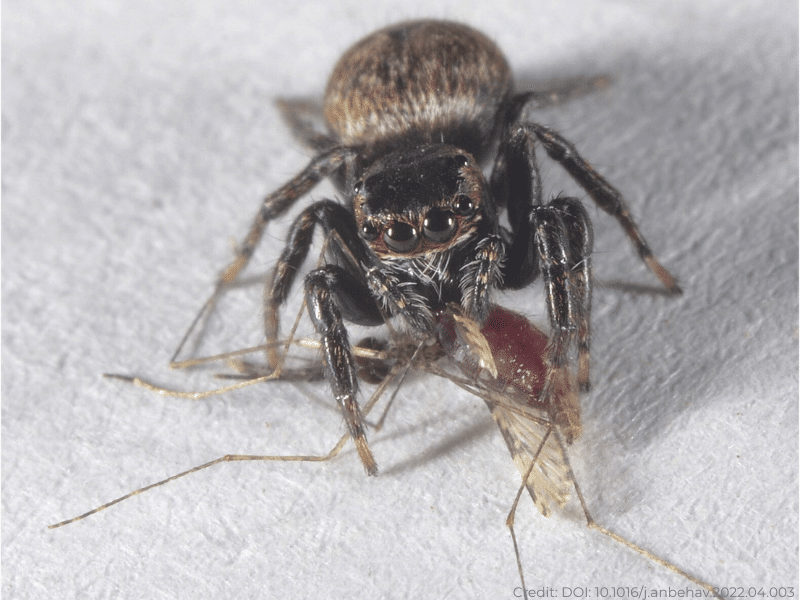
The East African jumping spider hunts female mosquitoes that have recently fed on blood. It can tell the difference between mosquitoes that have fed and those that haven’t and prefer the blood-filled ones. Eating these mosquitoes also changes the spider’s body scent, which may make it more attractive to potential mates.
The study of sanguivores continues to reveal just how unique blood-feeding can be.
