What Sustainability in Practice Looked Like at Tandem Global Conference 2026
Sustainability is increasingly defined not by commitments alone, but by how organizations put them into practice. At the 2026 Tandem Global Conference in Austin, Texas, leaders from business, government, and the nonprofit sector shared practical examples of how they’re applying technology, strengthening resource stewardship, and engaging employees to address today’s sustainability challenges. Across discussions on artificial intelligence, water, and biodiversity, one message was consistent: meaningful progress depends on turning ideas into action.
Putting AI to Work for Sustainability
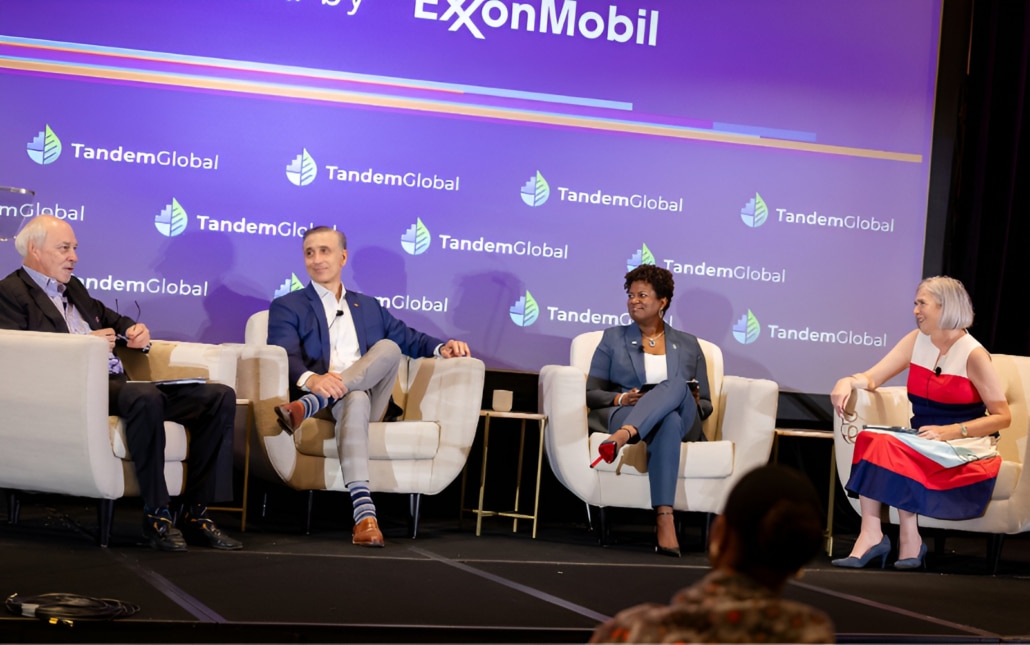
Artificial intelligence has become one of the most discussed technologies shaping business today, but the conversation at Tandem Global Conference 2026 focused less on what AI could eventually do and more on how organizations are already applying it to solve practical challenges. During the opening mainstage session, moderated by Margaret O’Gorman, CEO of Tandem Global, Bill Cobb, VP and Chief Sustainability Officer at Freeport-McMoRan, Eunice Heath, SVP and Chief Sustainability Officer at CRH, and Emilio Tenuta, SVP and Chief Sustainability Officer at Ecolab, explored how AI is being integrated into operations to improve safety, increase efficiency, and support better environmental decision-making.
Across industries, the panelists emphasized that successful AI adoption begins with understanding business needs. At CRH, AI applications are evaluated through a focus on operational efficiency and leadership oversight. Heath shared how the company uses technologies such as SPOT, a robotic platform that can enter areas where sending employees could create unnecessary risk. Across CRH’s more than 1,300 extractive sites, AI and autonomous equipment are helping support preventative maintenance and allow teams to deploy resources more effectively. The company is also exploring tools that can help municipalities identify issues such as water system leaks, demonstrating how AI can support broader infrastructure challenges.
For Ecolab, the conversation centered on how AI can help organizations better understand and manage one of the world’s most critical resources. As demand for data centers continues to grow, Tenuta encouraged attendees to consider not only the water required to support AI infrastructure but also the ways AI can help address water challenges. Ecolab’s approach focuses on making water use more circular and using data to identify opportunities for improvement. Through tools such as Water Navigator IQ, the company is helping organizations understand water stress and make more informed decisions about water withdrawals, efficiency, and operational planning. Tenuta also highlighted examples where AI and smart technology have helped industrial facilities identify opportunities to reuse water and improve performance in water-constrained regions.
Freeport-McMoRan approaches AI through the lens of operational improvement. Cobb explained that the company’s investments are focused on making operations more efficient, which can also create environmental benefits by reducing fuel use and improving resource management. The more recent autonomous haul trucks and remote operating centers are examples of how the company is using technology to transform its operations. AI is also helping Freeport evaluate restoration efforts and better understand what strategies are working overtime, supporting decisions about future investments.
While the applications vary, the message from all three leaders was consistent. AI is a tool that can help organizations work more effectively, but it requires clear objectives, strong governance, and human judgment. The technology can provide data and insights, but decisions about how to respond remain with people.
As Tenuta noted during the discussion, “AI is inevitable. Protecting our natural resources is not.”
Confronting Texas’ Water Future
Austin was an appropriate place to discuss the future of water. A rapidly growing region facing drought, extreme heat, and increasing demand, the city reflects many of the challenges communities across Texas are confronting. During the conference’s final mainstage session, Adam Butler moderated a discussion with Sarah Schlessinger, CEO of Texas Water Foundation, Joni Carswell, CEO and President of Texan by Nature, and Shay Ralls Roalson, Director of Austin Water, on how communities, utilities, and businesses can prepare for a changing water landscape.
The conversation moved beyond the question of whether Texas has enough water. Instead, panelists examined the broader systems required to manage a shared resource, including infrastructure investment, groundwater protection, long-term planning, and collaboration among utilities, companies, and communities. Joni Carswell highlighted the scale of Texas’ water challenges, pointing to aging infrastructure and planning gaps as factors shaping the state’s future. She noted that companies have opportunities to contribute through investments in projects with established standards and measurable outcomes while also supporting the communities where they operate. Corporate water stewardship, she emphasized, is becoming less of a voluntary initiative and more of a requirement for businesses planning for long-term success in Texas.
Schlessinger built on that point by describing how organizations are increasingly viewing water security as a business risk that extends beyond their own operations. Companies must consider not only their direct water use but also the broader systems and communities that make their operations possible. She argued that Texas’ challenge is not simply a question of water availability, but also one of infrastructure and efficiency. Strengthening the human systems that manage water will be essential, and she encouraged a future where water is treated as a broader community priority rather than an issue addressed only during periods of crisis.
That need for shared responsibility was also reflected in Roalson’s perspective from the utility side. As communities grow, utilities are making generational investments while balancing financial sustainability and affordability for customers. She discussed how utilities are working with new and existing customers through water benchmarking to better understand demand, identify efficiency opportunities, and explore ways to reduce overall consumption. Those conversations can influence decisions far beyond industrial processes, including landscaping choices and the broader question of how communities use water. For utilities, businesses, and residents alike, understanding where water comes from and how individual decisions affect shared resources will be essential to building long-term resilience.
The discussion reinforced that Texas’ water future will depend on partnership. Addressing the state’s challenges will require better planning and a shared understanding that water security is a responsibility that extends across sectors.
Nature as a Catalyst for Employee Engagement
Many biodiversity conversations center on what can be measured, including habitat restoration and conservation targets. This discussion focused on something less tangible but equally important, how nature initiatives can influence workplace culture and inspire broader participation in sustainability efforts. Examples from CRH and CalPortland demonstrated how those effects can emerge in organizations of very different sizes.
For Carolyn Jewell, Senior Manager of Biodiversity and Natural Resources at CRH, building that kind of momentum requires engaging employees at scale. CRH operates from roughly 4,000 locations and employs more than 83,000 people worldwide, making participation an important component of the company’s biodiversity strategy. Internal networks connect biodiversity specialists and employees with a shared interest in nature, creating opportunities to exchange ideas and replicate successful projects across the organization. Those connections also support broader goals, including CRH’s commitment to have 1,000 locations take action to support pollinators by 2030.
Jewell shared several examples of how engagement can begin with simple activities. During Mental Health Awareness Month, employees were invited to participate in Lunch and Listen, an initiative encouraging people to spend time observing birds, whether at home or at a company site. Employees submitted 833 observations representing 201 identified species, including two classified as vulnerable and two considered near threatened. One participant recorded 43 species, while the Eurasian robin was the most frequently observed bird. The initiative demonstrated how everyday interactions with nature can generate enthusiasm and help employees see biodiversity as something they can actively support rather than simply observe.
Karin Perissinotto, Sustainability Manager at CalPortland, shared a different example, one that began with a relatively modest project on a single site.
At CalPortland’s El Segundo Ready Mix Plant, a habitat-focused landscape project was originally designed to improve safety and create a more welcoming landscape between an industrial facility, a nearby residential area, and a school. Native habitat and pollinator-friendly plantings transformed a small space within a heavily industrial corridor, but the effects extended well beyond the project’s original objectives. As the landscape matured, employees would increasingly spend time there during breaks. Informal conversations developed around the new habitat, and employees began engaging with the area in ways that had not been anticipated. Some drivers even referred to it as their “happy space.” The site prompted a broader reflection on how organizations define value. Environmental outcomes can be measured, but some benefits become visible in other ways through employee experiences and workplace culture.
Looking Ahead
As Tandem Global Conference 2026 concluded in Austin, we look forward to seeing how this year’s ideas, partnerships, and discussions continue to shape the Tandem Global community. The conversation will continue next year when Tandem Global Conference heads to Chicago in 2027.

