Skip to content
  • About
    • About Tandem Global
      • Mission, Vision, Values
      • Our Brand
      • Our People
      • Careers
      • Contact
    • Our Network
      • Meet Our Members
      • Member Spotlights
      • Become a Member
      • Sponsorships
  • Work with Us
    • Consulting Services
      • We connect leading thinking with practical solutions that positively impact climate, nature, and water.
    • Certification
      • About Certification
      • Awards and Recognition
      • Executive Advisory Committee
      • Official Signage
      • Log-In or Register
      • Support Center
    • Social Impact
      • Programs that revitalize ecosystems, strengthen green spaces, and foster economic opportunities.
    • Thought Leadership
      • Cutting-edge events and content
  • Learn More
    • News & Insights
      • From the CEO
      • Blog
      • Industry News
      • Press
    • Resources
      • White Papers
      • Index of WHC-Certified Programs
      • Reports and Toolkits
      • Project Guidances
    • Events
      • Tandem Global Conference 2026
      • Webinars
      • Executive Meetings
      • Elevate Network
  • Certification Login
  • Become a Member
  • Click to open the search input field Click to open the search input field Search
  • Menu Menu
  • About
    • Who We Are
      • Mission, Vision, Values
      • Our Brand
      • Our People
      • Careers
      • Contact
    • Our Network
      • Meet Our Members
      • Member Spotlight
      • Become a Member
      • Sponsorships
  • Work with Us
    • Consulting Services
    • Certification
      • About Certification
      • Awards and Recognition
      • Executive Advisory Committee
      • Official Signage
      • Log-In or Register
      • Certification Support Center
    • Social Impact
    • Thought Leadership
  • Learn More
    • News & Insights
      • From the CEO
      • Blog
      • Industry News
      • Press
    • Resources
      • White Papers
      • WHC Index
      • Reports and Toolkits
      • Project Guidances
    • Events
      • Tandem Global Conference 2026
      • Webinars
      • Executive Thought Leadership Events
      • Elevate Network
  • Certification Login
  • Become a Member

Peregrines: Not Your Average City Dweller

June 21, 2016/by Colleen Beaty

One of my favorite bird species is the spectacular bird-of-prey, the peregrine falcon (Falco peregrinus). This bird can be found on six continents around the world, though it does not occur in large numbers in most areas.

This bird is amazing because not only has it recovered from the brink of extinction in North America, it is now thriving in many regions because it has adapted really well to urban settings. It naturally nests on ledges high up on cliffs, easily out of reach of most predators. With the increasing growth of cities with tall buildings and abundant prey in the modern era, peregrines have found new nesting opportunities on the roofs and ledges of skyscrapers and other tall structures like water towers, power pylons, and bridges.

At WHC’s main office in Silver Spring, we routinely see the resident pair of peregrine falcons soaring high above us and hunting the city’s numerous pigeons. Peregrines and other falcons are aerial hunters, meaning they catch their prey while in flight. Peregrines use a swift dive, or “stoop,” that is spectacular to watch. A peregrine’s stoop can reach over 200 mph (320 kmh), making it the fastest animal on earth!

These birds are known for using their speed and agility to prey upon a wide variety of birds, mostly medium-sized birds, including several species that can be a nuisance in urban settings like pigeons and starlings. Although falcons won’t eliminate the pigeon or starling population in a city, they can certainly help to keep it in check.
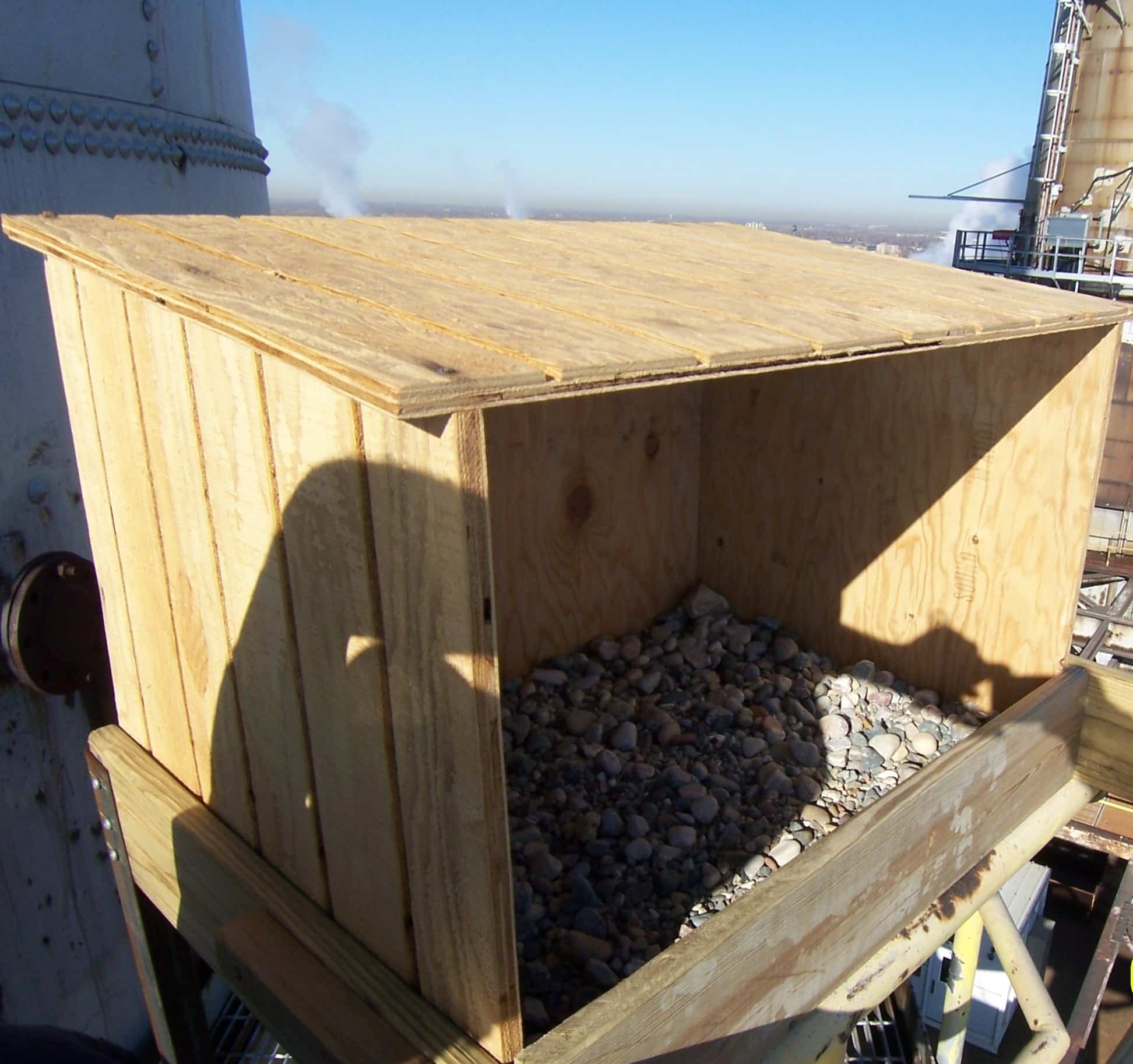
A nest box like this one at DTE’s River Rouge facility is a common way to enhance habitat for peregrines.

A nest box like this one at DTE’s River Rouge facility is a common way to enhance habitat for peregrines.

If you want to help peregrines at your corporate facility, one of the best ways is to work with your state wildlife agency to implement the appropriate measures for your site. These birds are still protected by law and can be very defensive of their nests, so before taking any actions it will be important to consult with the agency about things like safety precautions or requirements related to their protection. A common and often successful project is the installation and monitoring of a nest box for peregrines. This kind of structure provides a secure, ledge-like nesting location that provides some protection against the elements, and many facilities use a nest cam to monitor the nest with minimal disturbance to the birds. Discussions with your wildlife agency will also help determine if other projects such as artificial raptor perches, banding of peregrine chicks, or release of captive-reared peregrines would be appropriate for your facility.

https://tandemglobal.org/wp-content/uploads/2016/06/DTE-River-Rouge-Peregrine.jpg 791 1053 Colleen Beaty https://tandemglobal.org/wp-content/uploads/2025/02/tandem-global-logo-exp.svg Colleen Beaty2016-06-21 10:49:432023-09-25 16:02:25Peregrines: Not Your Average City Dweller

Migratory Species are Blind to Borders, But We are Not

June 15, 2016/by Lauren Gros

Migratory species from sandhill cranes to polar bears travel thousands of miles each year as the seasons change. Without the aid of GPS technology they find their way with an instinct as old as each species itself. This instinct allows them to traverse both natural and man-made landscapes effortlessly without regard for state lines or international borders. Despite migratory species’ remarkable navigational skills, their journeys are not always safe, and their destinations may no longer exist in their natural forms upon their arrival.

When it comes to protecting migratory species, thinking within the boundaries of your own backyard is not enough. If the bald eagle enjoys safe refuge in Alaska during the summer months but finds their habitat devastated by human activities when it migrates to California for the winter, their life is still in grave danger.

International law has begun the expansive process of protecting migratory species. Globally, states that have ratified the Convention of the Conservation of Migratory Species of Wild Animals (CMS) recognize that they are the protectors of migratory species that live within or pass through their national boundaries. Therefore, member states seek “to conserve the habitat of migratory species that would significantly benefit from international cooperation.” These conservation efforts are required to include trans-national coordinated conservation and management plans. North American countries are not a part of the CMS agreement, but they do work to conserve migratory birds through enforcement of the U.S. Migratory Bird Treaty Act of 1918. This treaty declares that killing, selling, and possessing migratory birds is a felony punishable by federal fines and imprisonment.

In addition to acting in accordance with conservation laws, corporate conservation teams can play an active role in protecting migratory species in other ways. For example, by using the free IPaC planning tool, it is possible to learn what species’ habitats are on your property and if those species are migratory. If any species are migratory, you can find out where they migrate to and contact corporations working in that region. The point of this contact should be to initiate a joint effort to protect and conserve your common migratory species. This communication could prove valuable to both corporate teams and wildlife, as the conservation effort could allow you collaborate with other corporations, while also ensuring the presence of both the summer and winter habitats needed by migratory species.

We cannot protect wildlife by thinking like a human. Instead, we must be willing to look at the world through the eyes of the migratory species we wish to protect, looking beyond their borders, and spotting new opportunities for connection.

Read more WHC blogs.

https://tandemglobal.org/wp-content/uploads/2016/06/WL_rose-breasted-grosbeak_bird_Benjamin-Moore-scaled.jpg 1365 2048 Lauren Gros https://tandemglobal.org/wp-content/uploads/2025/02/tandem-global-logo-exp.svg Lauren Gros2016-06-15 10:42:492023-11-28 11:31:32Migratory Species are Blind to Borders, But We are Not

Collaborations for Conservation: Keystone Policy Center honors WHC, GM and Toyota as national leaders in sustainability

June 10, 2016/by Patricia Leidemer

SILVER SPRING, MD, JUNE 8, 2016 – The Wildlife Habitat Council (WHC), along with its members General Motors and Toyota Motor North America, have been jointly honored with the 23rd Annual Keystone Policy Center Leadership in Environment Award, recognizing their partnership to expand wildlife habitat, support pollinator health, and enhance biodiversity around the world.

Accepting the award will be Margaret O’Gorman, President, WHC; Kevin Butt, Regional Director, Toyota North American environmental division; and Greg Martin, Executive Director, Global Public Policy, General Motors Company.

“We’re honored to share this award with General Motors and Toyota,” said O’Gorman. “Only 10 percent of Fortune Global 500 companies have adopted biodiversity goals, including GM and Toyota, and as such, their efforts towards conservation and biodiversity across the globe are exemplary models for other corporations to follow.”

The Keystone Policy Center, a Colorado-based nonprofit organization founded in 1975, also presented the following awards at a dinner ceremony at The Newseum in Washington, D.C. on June 8, 2016:

  • Spirit of Keystone Award to John Echohawk, Executive Director of the Native American Rights Fund
  • The Founder’s Award to Ken Powell, Chairman & Chief Executive Officer of General Mills
  • Leadership in Energy to the 51st State, an Initiative of the Smart Electric Power Alliance
  • Leadership in Government to U.S. Senator Kelly Ayotte of New Hampshire
  • Leadership in the Public Interest to Judy Woodruff, co-anchor and managing editor of the PBS NewsHour
  • Dignitaries, including Bob Perciasepe, president of the Center for Climate and Energy Solutions, former U.S. Ambassador to Morocco Edward Gabriel, former Colorado Gov. Bill Ritter, Environmental Defense Fund’s Fred Krupp, The Nature Conservancy’s Glenn Prickett, and Shelby Coffey III, Vice Chairman of The Newseum

About Wildlife Habitat Council

Wildlife Habitat Council promotes and certifies habitat conservation and management on corporate lands through partnerships and education. WHC’s programs take corporate sustainability goals and objectives and translate them into tangible and measurable on-the-ground actions. WHC membership includes 85 corporations, many of which are Fortune 500 companies, including Bridgestone, Chevron, DuPont, Exelon, Freeport-McMoRan, General Motors, Pacific Gas & Electric and Waste Management. WHC-assisted wildlife habitat and conservation education programs are found in 45 states and 13 countries. www.wildlifehc.org

About Keystone Policy Center

The Keystone Policy Center has worked at the forefront of public policy and dispute resolution for more than 40 years. From energy to education and health to sustainability, Keystone’s work has shaped public policy debates at local, state, and national levels. Keystone’s exceptional combination of experience and expertise have led to groundbreaking progress and lasting solutions when all other efforts have failed. www.keystone.org

About General Motors

General Motors Co. (NYSE:GM, TSX: GMM) and its partners produce vehicles in 30 countries, and the company has leadership positions in the world’s largest and fastest-growing automotive markets. GM, its subsidiaries and joint venture entities sell vehicles under the Chevrolet, Cadillac, Baojun, Buick, GMC, Holden, Jiefang, Opel, Vauxhall and Wuling brands. More information on the company and its subsidiaries, including OnStar, a global leader in vehicle safety, security and information services, can be found at http://www.gm.com.

About Toyota

Toyota (NYSE:TM), the world’s top automaker and creator of the Prius and the Mirai fuel cell vehicle, is committed to building vehicles for the way people live through their Toyota, Lexus and Scion brands. Toyota partners with philanthropic organizations across the country, with a focus on education, safety and the environment.  As part of this commitment, we share the company’s extensive know-how garnered from building great cars and trucks to help community organizations and other nonprofits expand their ability to do good. For more information about Toyota, visit www.toyotanewsroom.com.

###


https://tandemglobal.org/wp-content/uploads/2016/06/Keystone-Award.jpg 1024 682 Patricia Leidemer https://tandemglobal.org/wp-content/uploads/2025/02/tandem-global-logo-exp.svg Patricia Leidemer2016-06-10 00:22:102023-07-17 02:54:23Collaborations for Conservation: Keystone Policy Center honors WHC, GM and Toyota as national leaders in sustainability

Pages

  • 2015 WHC Award Winners and Finalists
  • 2016 WHC Award Winners and Nominees
  • 2017 WHC Award Winners and Finalists
  • 2018 WHC Award Winners and Finalists
  • 2019 WHC Award Winners and Finalists
  • 2020 WHC Award Winners and Finalists
  • 2021 WHC Awards Winners and Finalists
  • 2022 WHC Awards Winners and Finalists
  • 2023 WHC Awards Winners and Finalists
  • 2024 Awards Dinner Menu
  • 2024 WHC Awards Winners and Finalists
  • 2025 Tandem Global Awards Winners and Finalists
  • Become a white paper sponsor
  • Brand Guidance for Members and Partners
  • Certification
  • Certification Support Center
  • Climate Action Works
  • Conference 2026 Speaker Guidelines
  • Conference 2026 Speaker Nominations
  • Conference Draft
  • Conservation Conference 2024 Agenda
  • Conservation Conference 2024 Exhibitor Form
  • Conservation Conference 2024 Exhibitors
  • Conservation Conference 2024 Travel Information
  • Consulting – From Old Site (Delete later)
  • EAC Confirmation
  • Earth Day and World Environment Day Events
  • Earth Day Planting Event
  • Events
  • Executive Thought Leadership Events
  • Five Star and Urban Waters Restoration Grant Program
  • Get Involved
  • Home
  • Industry News
  • Nature Steward Alliance
  • Nature-based Solutions for Pollution Prevention
  • Nesting Structure Challenge
  • New to Certification?
  • News & Insights
  • Official Signage
  • Our Brand
  • Our Brand (copy)
  • Our Network
  • Our Origin Short Story
  • Payment Center and Donations
  • Payment Confirmation
  • Payment Failed
  • Planting Event Registration | October 18
  • Planting Event Registration | October 25
  • Pollinators
  • PR Materials for Certified Programs
  • Privacy Policy
  • Project Guidances
  • Project Guidances Overview
  • Registration Information
  • Reports and Toolkits
  • Saving Bats from Decline
  • Social Impact
  • Spirit Award
  • Sponsor Events, Content and Programming
  • Sponsor Interest Form
  • Sponsor webinars
  • SS Project
  • SS Search Results
  • STEM and Environmental Education
  • Style Guide
  • Subscribe
  • Tandem Global Awards Dinner Program and Menu
  • Tandem Global Conference 2025 Agenda
  • Urban Forestry
  • WHC at COP16
  • WHC Project Guidances
  • Who We Are
  • About Certification
  • Application Overview
  • Attend an Event
  • Conservation Certification Versioning
  • Conservation Conference 2024
  • Consulting Services
  • Executive Advisory Committee
  • External Review Process
  • Fees
  • From the CEO
  • Meet Our Members
  • Mission, Vision, Values
  • Monitoring Templates
  • Navigation Tips
  • Overview of Requirements
  • Privacy and Security Policies
  • Project Types
  • Recognition
  • Social Impact
  • Tandem Global Conference 2025
  • Tandem Global Conference 2026
  • Thought Leadership
  • What is WHC Certification?
  • WHC Index
  • Awards
  • Awards and Recognition
  • Blog
  • Careers
  • COVID-19 Accommodations
  • Create an Account
  • Determining Your Project Types
  • Generating an Invoice
  • Habitat Project Requirements
  • Habitat Species Inventories
  • How Your Application is Evaluated
  • Issue-Based Initiatives
  • Key Considerations for Applying
  • Member Spotlight
  • Stakeholder Input
  • Understanding Project Types
  • Webinars
  • What It Means to Be Certified
  • White Papers
  • Become a Member
  • Contact
  • Elevate Network
  • Informational Videos
  • Managing Your Account
  • Marketing Support
  • Our People
  • Paying Invoices
  • Point Values
  • Press
  • Renewal Applications
  • Species Project Requirements
  • Value of WHC Certification
  • WHC Awards
  • Working in the Certification Website
  • Deadlines
  • Education Project Requirements
  • How to Apply
  • Program Registration
  • Scoring Sheets
  • Site and Program Contacts – Start Here
  • Add People/Edit or Remove Permissions
  • Application Outcomes
  • Corporate Contacts – Start Here
  • Finalizing and Submitting Your Application
  • Other Options Project Requirements
  • Requirements
  • Adding, Editing and Deleting Projects
  • Appeals
  • Common Evaluation Criteria
  • Invoices and Payments
  • Application Forms
  • Habitat Project Evaluation Criteria
  • Review and Evaluation
  • Printing Your Application
  • Resources
  • Species Project Evaluation Criteria
  • Education Project Evaluation Criteria
  • Potential Error Messages
  • Recognition and Awards
  • Additional Assistance
  • Certification Standard
  • Other Options Project Evaluation Criteria
  • Policies
  • Status Dictionary

Categories

  • Avian
  • Awareness and Community Engagement
  • Bats
  • Caves and Subterranean
  • CEO Blog
  • Client Case Studies
  • Desert
  • Education & Awareness
  • Forest
  • Formal Learning
  • Grasslands
  • Green Infrastructure
  • Habitat
  • Integrated Vegetation Management
  • Invasive Species
  • Land Conservation Agreements
  • Landscaping
  • Mammals
  • Marine Intertidal
  • Member Spotlight
  • Other Options
  • Pollinators
  • Press Release
  • Remediation
  • Reports and Toolkits
  • Reptiles and Amphibians
  • Rocky Areas
  • Social Impact
  • Species Management
  • Species of Concern
  • Tandem Global Blog
  • Training
  • Uncategorized
  • Wetlands
  • White Paper

Archive

  • December 2025
  • November 2025
  • October 2025
  • September 2025
  • July 2025
  • June 2025
  • April 2025
  • March 2025
  • February 2025
  • January 2025
  • November 2024
  • October 2024
  • September 2024
  • August 2024
  • July 2024
  • June 2024
  • May 2024
  • April 2024
  • March 2024
  • February 2024
  • January 2024
  • December 2023
  • November 2023
  • October 2023
  • August 2023
  • July 2023
  • June 2023
  • May 2023
  • February 2023
  • January 2023
  • December 2022
  • November 2022
  • October 2022
  • September 2022
  • August 2022
  • July 2022
  • June 2022
  • March 2022
  • December 2021
  • November 2021
  • October 2021
  • August 2021
  • July 2021
  • June 2021
  • May 2021
  • April 2021
  • March 2021
  • February 2021
  • January 2021
  • December 2020
  • November 2020
  • October 2020
  • September 2020
  • August 2020
  • June 2020
  • May 2020
  • February 2020
  • January 2020
  • December 2019
  • November 2019
  • September 2019
  • July 2019
  • June 2019
  • May 2019
  • February 2019
  • January 2019
  • December 2018
  • November 2018
  • September 2018
  • August 2018
  • June 2018
  • May 2018
  • March 2018
  • February 2018
  • January 2018
  • November 2017
  • September 2017
  • August 2017
  • July 2017
  • June 2017
  • May 2017
  • April 2017
  • March 2017
  • February 2017
  • January 2017
  • December 2016
  • November 2016
  • October 2016
  • September 2016
  • August 2016
  • July 2016
  • June 2016
  • May 2016
  • April 2016
  • January 2016
  • December 2015
  • November 2015
  • October 2015
  • September 2015
  • August 2015
  • June 2015
  • May 2015
  • April 2015
  • February 2015
  • January 2015
  • December 2014
  • November 2014
  • October 2014
  • September 2014
  • July 2014
  • May 2014
  • April 2014
  • March 2014
  • February 2014
  • January 2012
  • June 2011
  • April 2011
About

About Tandem Global
Mission, Vision, Values
Our Brand
Our People
Careers
Contact

Our Network
Meet Our Members
Member Spotlights
Become a Member
Sponsorships

Financials and Policies
Privacy Policy

Work with Us

Consulting Services

Certification
About Certification
Awards and Recognition
Executive Advisory Committee
Official Signage
Log-in or Register
Support Center

Social Impact

Thought Leadership

Learn More

News & Insights
From the CEO
Blog
Industry News
Press

Resources
White Papers
Index of WHC-Certified Programs
Project Guidelines

Events
Tandem Global Conference 2025
Webinars
Executive Meetings
Elevate Network

Member

UN Global Compact
Business for Nature

Official ally

World Benchmarking Alliance

Subscribe for Updates
Payment Center

Connect with us on Linkedin

About

About Tandem Global
Mission, Vision, Values
Our Brand
Our People
Careers
Contact

Our Network
Meet Our Members
Member Spotlights
Become a Member
Sponsorships

Financials and Policies
Privacy Policy

Work With Us

Consulting Services

Certification
About Certification
Awards and Recognition
Executive Advisory Committee
Official Signage
Log-in or Register
Support Center

Social Impact

Thought Leadership

Learn More

News & Insights
From the CEO
Blog
Industry News
Press

Resources
White Papers
Index of WHC-Certified Programs
Project Guidelines

Events
Tandem Global Conference 2025
Webinars
Executive Meetings
Elevate Network

Member of UN Global Compact Business for Nature

Official Ally: World Benchmarking Alliance

Sign Up For Updates

Subscribe
Payment Center

Connect with us on Linkedin

Scroll to top Scroll to top Scroll to top