Skip to content
  • About
    • About Tandem Global
      • Mission, Vision, Values
      • Our Brand
      • Our People
      • Careers
      • Contact
    • Our Network
      • Meet Our Members
      • Member Spotlights
      • Become a Member
      • Sponsorships
  • Work with Us
    • Consulting Services
      • We connect leading thinking with practical solutions that positively impact climate, nature, and water.
    • Certification
      • About Certification
      • Awards and Recognition
      • Executive Advisory Committee
      • Official Signage
      • Log-In or Register
      • Support Center
    • Social Impact
      • Programs that revitalize ecosystems, strengthen green spaces, and foster economic opportunities.
    • Thought Leadership
      • Cutting-edge events and content
  • Learn More
    • News & Insights
      • From the CEO
      • Blog
      • Industry News
      • Press
    • Resources
      • White Papers
      • Index of WHC-Certified Programs
      • Reports and Toolkits
      • Project Guidances
    • Events
      • Tandem Global Conference 2026
      • Webinars
      • Executive Meetings
      • Elevate Network
  • Certification Login
  • Become a Member
  • Click to open the search input field Click to open the search input field Search
  • Menu Menu

Tandem Global Releases Executive Roundtable Summary on Supply Chain Collaboration for Sustainability

October 28, 2025/by Monica Keller

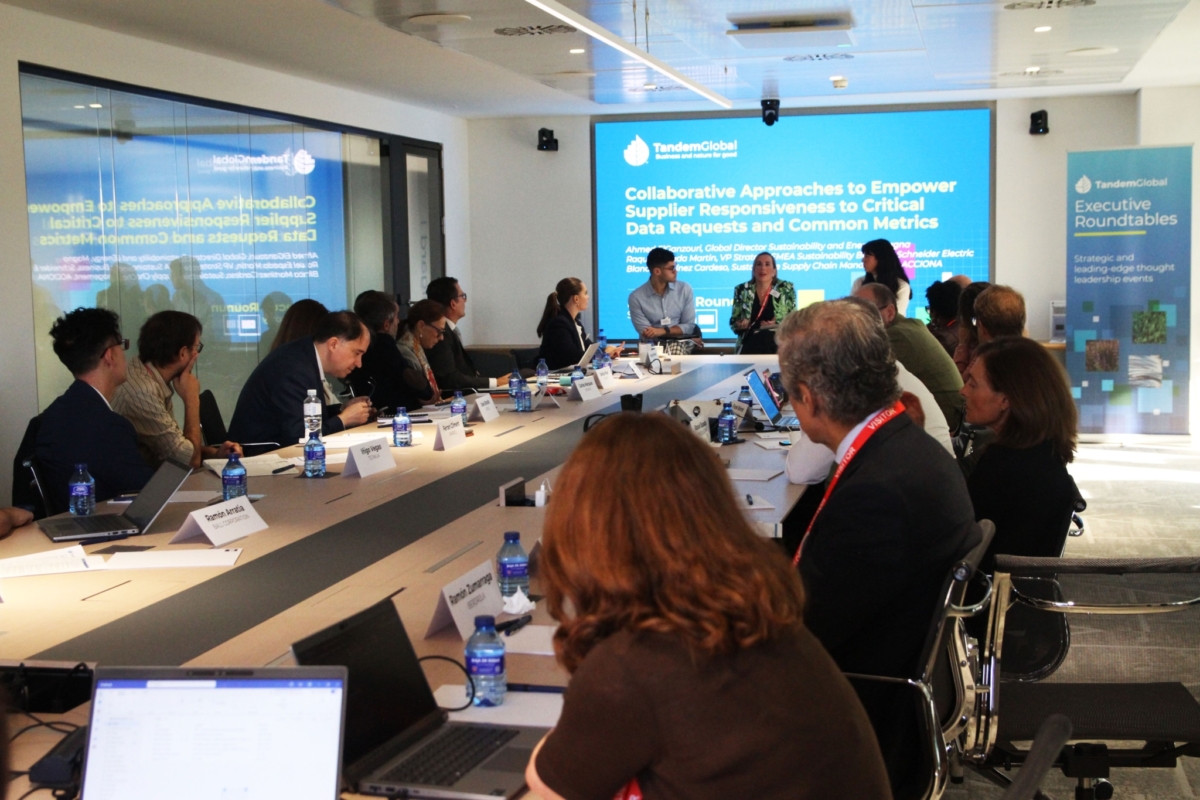
Bethesda, MD – October 28, 2025 – Tandem Global is pleased to announce the publication of its latest Executive Roundtable Summary: “Supply Chain Collaboration for Sustainability,” reflecting insights from the Roundtable held in Madrid on October 1-2, 2025, sponsored by CRH. The full summary is available here.

Key Highlights

The summary draws on candid, solutions-oriented discussions among 30 senior sustainability and procurement executives from global companies, facilitated by Tandem Global and moderated by industry experts.

Topics covered include:

  • How companies can cascade sustainability goals throughout their value chains and engage suppliers in meaningful ways.
  • The importance of supplier training, data transparency, and dual dashboards to strengthen supplier responsiveness.
  • Challenges and best practices for leveraging AI, tracking Scope 3 emissions, and developing more sustainable products through supplier collaboration.

Sponsors and participants included major industry players and experts from sectors including chemicals, construction, aerospace, and energy.

Why this Summary Matters

In an era where the bulk of many companies’ environmental and social impact lies deeper in their supply chains, the need for collaborative, strategic action is more urgent than ever. According to the Roundtable, the keys to meaningful progress include:

  • Building a shared understanding of sustainability challenges across customers and suppliers.
  • Aligning procurement and sustainability teams to integrate sustainability into core business practices—not just as a separate function.
  • Leveraging digital tools and data (including AI and dashboards) for multi-tier supplier engagement and performance tracking.
  • Cultivating supplier empowerment, training, and co-innovation rather than top-down mandates alone.

For sustainability leaders, procurement professionals, and value-chain stakeholders, this summary offers actionable insights and a forward-thinking framework to drive supplier collaboration initiatives.

Availability

The Executive Roundtable Summary is freely accessible as a PDF download here.

Tandem Global encourages professionals engaged in supply-chain sustainability and supplier collaboration to review and share the document with relevant teams and stakeholders.

Upcoming Executive Roundtable

February 25–26, 2026 | Washington, D.C. | Sponsored by Beveridge & Diamond

As part of its Executive Roundtable Series, Tandem Global will convene 35 senior sustainability, communications, and legal experts from global companies across North America and Europe to explore the topic: Ambition Meets Regulation: Strategy and Risk Management in Sustainability – Goal-Setting and Disclosures.

This invitation-only roundtable will be held under the Chatham House Rule.

To request participation or learn more about sponsorship opportunities, please contact Frank Werner.

https://tandemglobal.org/wp-content/uploads/2025/10/IMG_9684-scaled-e1761669464899.jpg 800 1200 Monica Keller https://tandemglobal.org/wp-content/uploads/2025/02/tandem-global-logo-exp.svg Monica Keller2025-10-28 12:38:592025-10-28 12:38:59Tandem Global Releases Executive Roundtable Summary on Supply Chain Collaboration for Sustainability

The Strange Lives of Nature’s Zombies

October 27, 2025/by Nas Soboh

What if I told you zombies are real? And no, not the ones you see on movie screens. I’m talking about nature’s zombies, real organisms hijacked and controlled by other living things. This phenomenon, often referred to as parasite manipulation, is found in most ecosystems throughout the world. Parasite manipulation can take shape in many forms, from subtle behavioral changes to dramatic transformations that make the host look and act like something out of a horror film.  

In these strange relationships, the “zombie” isn’t dead, at least not yet, but it’s no longer in full control of its own body. Tiny fungi, bacteria, and worms can essentially rewrite the host’s brain, forcing it to behave in ways that benefit the parasite rather than the animal itself. A caterpillar might climb to the tip of a plant, paralyzed by a fungus, only to be consumed from within as the fungus spreads its spores. Crickets can be compelled to jump to their grave, where they are then eaten alive by microscopic puppeteers.  

Parasites often produce chemicals that mimic or interfere with their host’s natural hormones and neurotransmitters. The result is a perfectly choreographed takeover. The host becomes a tool, unknowingly carrying out the parasite’s reproductive or survival agenda. Unlike fictional zombies, these manipulations are highly specific. Each parasite knows exactly how to influence its host to maximize its own chance of survival, whether that means altering movement or feeding behavior. 

But what does this look like in practice? How does a fungus convince an ant to march to its death, or a parasitic worm drive a cricket to take its own life? Scientists still don’t fully understand how these parasites control their hosts, but their mysteries open the door to the strange world of nature’s real-life zombies. 

For instance, the fungus Ophiocordyceps, often dubbed the “zombie-ant fungus”, may appear to be just another harmless organism, but its relationship with ants is nothing short of terrifying. The fungus attaches to the body of an ant, secreting enzymes that dissolve the ant’s tough exoskeleton, allowing the fungus to penetrate and begin the infection. Once an ant is infected, the fungus slowly takes over its central nervous system, manipulating it to leave the safety of its colony and aimlessly climb vegetation. Once high enough, the ant clamps down on a leaf or twig in what scientists call a “death grip,” where it ultimately dies as the fungus eats through its body, releasing spores to infect the next unlucky ant.  

Another unsettling example comes from Nematomorph hairworm parasites that live inside grasshoppers and crickets. The worm begins its life in water, hatching as a tiny larva that is ingested by small aquatic organisms like aquatic isopods and amphipods. When a cricket or grasshopper ingests one of these small organisms, the worm enters its body and begins a slow-growing invasion. Over the next few months, the long, thin worm grows inside the insect, preparing for reproduction. When the worm reaches maturity, it releases chemicals that literally rewire the cricket’s brain. The cricket suddenly feels an irresistible urge to jump into water. Once the cricket drowns, the hairworm emerges from the cricket’s body and enters the water to continue its life cycle, leaving the cricket’s body as an empty shell.  

The green-banded broodsac flatworm uses an interesting strategy to complete its life cycle. It begins by infecting a snail, its first host, where it eventually moves into the snail’s eye stalks. There, the parasite causes the stalks to swell and pulse with bright green and yellow bands that resemble small caterpillars, an appetizing target for birds. The infection also changes the snail’s behavior. Instead of hiding in the shade, the snail becomes unusually active and crawls into the open during the day, making itself more visible to predators. When a bird eats the infected snail, the flatworm reaches its final host and reproduces inside the bird’s digestive system. In this way, the parasitic flatworm uses the snail as both transportation and bait to attract its intended target. 

Unlike the green-banded broodsac, the Glyptapanteles takes on a more direct approach. This parasitic wasp is found on every continent except Antarctica and takes manipulation to an entirely new level. It lays its eggs inside the caterpillar of the geometrid moth, where the larvae feed on the host from within. When they are ready to pupate, the larvae consume the host from within and emerge to spin cocoons on surrounding vegetation. Remarkably, the caterpillar doesn’t immediately die. Instead, it undergoes a dramatic behavioral transformation, standing guard over the newly formed pupae. The caterpillar stops moving and feeding, positioning itself close to the pupae, and when threatened, violently swinging its head to deter potential predators. This self-sacrificial behavior significantly reduces predation on the pupae, increasing their survival rates. However, the caterpillar’s fate is sealed; it dies shortly after the wasp larvae emerge as adults, having unwittingly served as a bodyguard. 

In observing nature’s zombies, we understand the reality of a world where autonomy is fragile. They’re reminders that in nature, control is an illusion, and every creature, including us, dances to the rhythm of unseen forces.  

https://tandemglobal.org/wp-content/uploads/2025/10/AE-Zombie-Ant-800x500-1.jpg 500 800 Nas Soboh https://tandemglobal.org/wp-content/uploads/2025/02/tandem-global-logo-exp.svg Nas Soboh2025-10-27 10:33:072025-10-27 17:13:11The Strange Lives of Nature’s Zombies

Transforming Empty Lots into Living Forests: The Miyawaki Way

October 13, 2025/by Nas Soboh

As urban infrastructure expands and cities grapple with rising temperatures, biodiversity loss, and degraded green spaces, an unconventional yet proven method of ecological restoration is quietly taking root around the world: Microforests. In his pioneering work, Japanese botanist Dr. Akira Miyawaki, introduces the microforest as a dense, fast-growing, and highly biodiverse approach to reforestation. What began as a botanical experiment in Japan has grown into a global movement, reshaping how we think about nature in cities.  

Creative Ecology: Restoration of Native Forests by Native Trees (1999), Dr. Miyawaki’s foundational paper, lays out the core principles of his revolutionary method: planting a variety of native species in carefully prepared soil, arranged in natural forest layers, to accelerate ecological succession. Unlike traditional plantations, which can take over a century to mature, microforests develop into self-sustaining ecosystems within just 20 to 30 years. His technique has been applied successfully across numerous sites worldwide, ranging from industrial zones to rural landscapes.  

Fast forward to our modern urban, industrial society, and the method’s relevance becomes even more apparent. A report by Urban Forests Company, The Miyawaki Method – Data & Concepts, compiled global case studies and quantified the method’s benefits: cooler urban microclimates, improved air quality, increased biodiversity, and greater community engagement. Most of the modern challenges that were a direct result of removing native habitats can be mitigated by reintroducing and reincorporating these native habitats back into our communities. In an era of climate uncertainty, these compact forests act as ecological hubs, restoring biodiversity, and reinforcing public trust in nature-based solutions.  

Versatile and adaptable by design, micro-forests can be implemented in a range of climates, like the dry landscapes of the Mediterranean. A 2011 study by Schirone, Salis, and Vessella put it to the test in Sardinia, Italy. Despite harsh summer droughts and poor soils, the researchers found that the Miyawaki method significantly outperformed conventional restoration efforts in both biodiversity and continued resilience. 

The success of micro-forestry isn’t limited to academic research or large-scale projects. In fact, one of the method’s greatest strengths is its scalability. With the right planning, even small plots of land, schoolyards, backyards, corporate campuses, or vacant lots, can become thriving micro-forests. 

How to Plant a Micro-Forest: A Step-by-Step Overview 

Step 1: Choose the Right Site 

The first step is site selection. It’s important to find a location that receives full sun and has at least one meter of plantable soil. Avoid areas like landfill caps or heavily compacted sites. You’ll also want to make sure the location has access to water, no underground utilities, and room for storing materials and saplings during installation. Ideal sites are easily accessible and offer visibility to maximize ecological and educational impact. 

Step 2: Identify Native Species 

Next, identify what species to plant. This begins by surveying a nearby native forest with similar conditions, matching factors like rainfall, slope, soil type, and altitude. Document the types of plants growing across the forest’s vertical structure: canopy trees, sub-trees, shrubs, and groundcover. A successful micro-forest includes species from each of these layers, as well as fringe plants like native grasses and forbs at the edges. Prioritize native species adapted to your specific region, and if collecting seeds isn’t possible, source appropriate nursery stock well in advance. 

Step 3: Prepare the Soil 

With your species selected, it’s time to prepare the soil. Start by testing texture, nutrients, and pH, either with a home kit or by sending samples to a local extension office. Amendments like compost or manure provide nutrients, while organic materials like peat or straw improve water retention. The introduction of organic material will also stimulate microbial life in the soil, a necessary component of a healthy ecosystem. Once mixed and aerated, cover the prepared ground with a thick layer of mulch. This helps retain moisture, suppress weeds, and protect beneficial microbes from sunlight. 

Step 4: Plant Densely and Randomly 

Planting should be done densely, typically with three to five seedlings per square meter. Mix species from different layers and scatter them in a natural, random pattern to mimic forest diversity. Seedlings should be at least a foot tall with signs of woody growth, and holes should be slightly larger than the root ball. Saturate the root ball with water and gently place each plant in its designated hole, backfill with soil and lightly compact. Avoid tight ties or anything that could constrain and damage the stem area. Once planted, water immediately simulates a full rainy day. 

Step 5: Water, Mulch, and Monitor 

Ongoing care is relatively simple. Watering should mimic the local climate, only water when soil moisture drops, and always check below the mulch layer before watering. Use hose heads that mimic rain and avoid excessively disturbing the mulch or seedlings. Weed manually for the first couple of years and refresh the mulch once or twice until the forest starts producing its own leaf litter. Avoid any pruning, chemicals, or fertilizers; this is a living system designed to sustain itself. 

Step 6: Let Nature Take Over 

Over time, the forest will begin to thrive on its own. Trees will shed leaves to build mulch, biodiversity will increase, and the need for active management will fade. Monitor growth by taking monthly photos from the same location and tracking survival rates and seedling heights. Some mortality is natural, aiming for around 90% survival, but don’t feel pressured to replace every plant, especially if one species is underperforming across the board. 

A Living Classroom in Valdosta, Georgia 

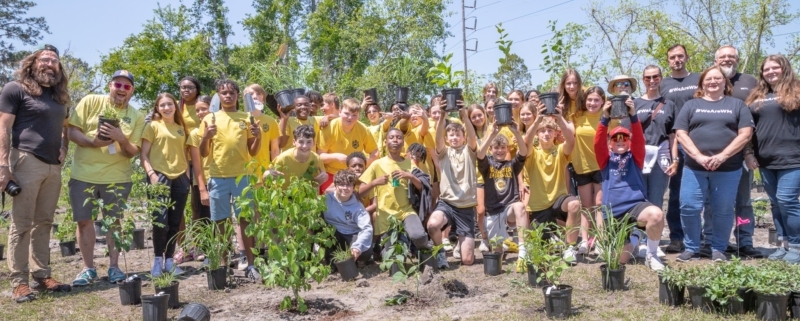
A recent example of this method in action took place in Valdosta, Georgia, where Tandem Global partnered with WM and the Valdosta Middle School STEM Academy to bring a microforest to life. Designed not only as a climate solution but also as a hands-on lesson, the 1,500-square-foot site now hosts over 600 native plants, transforming what was once Bermuda grass into a preliminary microforest. Over 90 middle school students participated in this collaborative planting. Supported by local staff and educators, the project emphasizes biodiversity, ecological function, and long-term stewardship. Species like crepe myrtle and white oak were carefully selected to support native wildlife, while the dense planting approach laid the foundation for a layered, self-sustaining forest. 

This small but impactful site sits in a region prone to flooding and hurricanes, making the improved drainage, deep-rooted plants, and increased soil stability all the more impactful. As the forest matures, it will serve not just as green infrastructure but as an ongoing classroom, offering students the chance to monitor changes in biodiversity, understand ecological relationships, and witness firsthand how nature can reclaim and revitalize an urban space. 

With several microforest projects planned through the rest of 2025, Tandem Global remains committed to applying the Miyawaki method, supporting the restoration and long-term preservation of native biodiversity across diverse landscapes. 

Want to learn more about microforests? Check out our webinar: Forestry on a Smaller Scale: Your Guide to Planting Microforests 
https://tandemglobal.org/wp-content/uploads/2025/09/WMVP25-19-scaled-e1758217185982.jpg 500 800 Nas Soboh https://tandemglobal.org/wp-content/uploads/2025/02/tandem-global-logo-exp.svg Nas Soboh2025-10-13 08:50:562025-10-13 13:25:35Transforming Empty Lots into Living Forests: The Miyawaki Way

Pages

  • 2015 WHC Award Winners and Finalists
  • 2016 WHC Award Winners and Nominees
  • 2017 WHC Award Winners and Finalists
  • 2018 WHC Award Winners and Finalists
  • 2019 WHC Award Winners and Finalists
  • 2020 WHC Award Winners and Finalists
  • 2021 WHC Awards Winners and Finalists
  • 2022 WHC Awards Winners and Finalists
  • 2023 WHC Awards Winners and Finalists
  • 2024 Awards Dinner Menu
  • 2024 WHC Awards Winners and Finalists
  • 2025 Tandem Global Awards Winners and Finalists
  • Become a white paper sponsor
  • Brand Guidance for Members and Partners
  • Certification
  • Certification Support Center
  • Climate Action Works
  • Conference 2026 Speaker Guidelines
  • Conference 2026 Speaker Nominations
  • Conference Draft
  • Conservation Conference 2024 Agenda
  • Conservation Conference 2024 Exhibitor Form
  • Conservation Conference 2024 Exhibitors
  • Conservation Conference 2024 Travel Information
  • Consulting – From Old Site (Delete later)
  • EAC Confirmation
  • Earth Day and World Environment Day Events
  • Earth Day Planting Event
  • Events
  • Executive Thought Leadership Events
  • Five Star and Urban Waters Restoration Grant Program
  • Get Involved
  • Home
  • Industry News
  • Nature Steward Alliance
  • Nature-based Solutions for Pollution Prevention
  • Nesting Structure Challenge
  • New to Certification?
  • News & Insights
  • Official Signage
  • Our Brand
  • Our Brand (copy)
  • Our Network
  • Our Origin Short Story
  • Payment Center and Donations
  • Payment Confirmation
  • Payment Failed
  • Planting Event Registration | October 18
  • Planting Event Registration | October 25
  • Pollinators
  • PR Materials for Certified Programs
  • Privacy Policy
  • Project Guidances
  • Project Guidances Overview
  • Registration Information
  • Reports and Toolkits
  • Saving Bats from Decline
  • Social Impact
  • Spirit Award
  • Sponsor Events, Content and Programming
  • Sponsor Interest Form
  • Sponsor webinars
  • SS Project
  • SS Search Results
  • STEM and Environmental Education
  • Style Guide
  • Subscribe
  • Tandem Global Awards Dinner Program and Menu
  • Tandem Global Conference 2025 Agenda
  • Urban Forestry
  • WHC at COP16
  • WHC Project Guidances
  • Who We Are
  • About Certification
  • Application Overview
  • Attend an Event
  • Conservation Certification Versioning
  • Conservation Conference 2024
  • Consulting Services
  • Executive Advisory Committee
  • External Review Process
  • Fees
  • From the CEO
  • Meet Our Members
  • Mission, Vision, Values
  • Monitoring Templates
  • Navigation Tips
  • Overview of Requirements
  • Privacy and Security Policies
  • Project Types
  • Recognition
  • Social Impact
  • Tandem Global Conference 2025
  • Tandem Global Conference 2026
  • Thought Leadership
  • What is WHC Certification?
  • WHC Index
  • Awards
  • Awards and Recognition
  • Blog
  • Careers
  • COVID-19 Accommodations
  • Create an Account
  • Determining Your Project Types
  • Generating an Invoice
  • Habitat Project Requirements
  • Habitat Species Inventories
  • How Your Application is Evaluated
  • Issue-Based Initiatives
  • Key Considerations for Applying
  • Member Spotlight
  • Stakeholder Input
  • Understanding Project Types
  • Webinars
  • What It Means to Be Certified
  • White Papers
  • Become a Member
  • Contact
  • Elevate Network
  • Informational Videos
  • Managing Your Account
  • Marketing Support
  • Our People
  • Paying Invoices
  • Point Values
  • Press
  • Renewal Applications
  • Species Project Requirements
  • Value of WHC Certification
  • WHC Awards
  • Working in the Certification Website
  • Deadlines
  • Education Project Requirements
  • How to Apply
  • Program Registration
  • Scoring Sheets
  • Site and Program Contacts – Start Here
  • Add People/Edit or Remove Permissions
  • Application Outcomes
  • Corporate Contacts – Start Here
  • Finalizing and Submitting Your Application
  • Other Options Project Requirements
  • Requirements
  • Adding, Editing and Deleting Projects
  • Appeals
  • Common Evaluation Criteria
  • Invoices and Payments
  • Application Forms
  • Habitat Project Evaluation Criteria
  • Review and Evaluation
  • Printing Your Application
  • Resources
  • Species Project Evaluation Criteria
  • Education Project Evaluation Criteria
  • Potential Error Messages
  • Recognition and Awards
  • Additional Assistance
  • Certification Standard
  • Other Options Project Evaluation Criteria
  • Policies
  • Status Dictionary

Categories

  • Avian
  • Awareness and Community Engagement
  • Bats
  • Caves and Subterranean
  • CEO Blog
  • Client Case Studies
  • Desert
  • Education & Awareness
  • Forest
  • Formal Learning
  • Grasslands
  • Green Infrastructure
  • Habitat
  • Integrated Vegetation Management
  • Invasive Species
  • Land Conservation Agreements
  • Landscaping
  • Mammals
  • Marine Intertidal
  • Member Spotlight
  • Other Options
  • Pollinators
  • Press Release
  • Remediation
  • Reports and Toolkits
  • Reptiles and Amphibians
  • Rocky Areas
  • Social Impact
  • Species Management
  • Species of Concern
  • Tandem Global Blog
  • Training
  • Uncategorized
  • Wetlands
  • White Paper

Archive

  • October 2025
  • September 2025
  • July 2025
  • June 2025
  • April 2025
  • March 2025
  • February 2025
  • January 2025
  • November 2024
  • October 2024
  • September 2024
  • August 2024
  • July 2024
  • June 2024
  • May 2024
  • April 2024
  • March 2024
  • February 2024
  • January 2024
  • December 2023
  • November 2023
  • October 2023
  • August 2023
  • July 2023
  • June 2023
  • May 2023
  • February 2023
  • January 2023
  • December 2022
  • November 2022
  • October 2022
  • September 2022
  • August 2022
  • July 2022
  • June 2022
  • March 2022
  • December 2021
  • November 2021
  • October 2021
  • August 2021
  • July 2021
  • June 2021
  • May 2021
  • April 2021
  • March 2021
  • February 2021
  • January 2021
  • December 2020
  • November 2020
  • October 2020
  • September 2020
  • August 2020
  • June 2020
  • May 2020
  • February 2020
  • January 2020
  • December 2019
  • November 2019
  • September 2019
  • July 2019
  • June 2019
  • May 2019
  • February 2019
  • January 2019
  • December 2018
  • November 2018
  • September 2018
  • August 2018
  • June 2018
  • May 2018
  • March 2018
  • February 2018
  • January 2018
  • November 2017
  • September 2017
  • August 2017
  • July 2017
  • June 2017
  • May 2017
  • April 2017
  • March 2017
  • February 2017
  • January 2017
  • December 2016
  • November 2016
  • October 2016
  • September 2016
  • August 2016
  • July 2016
  • June 2016
  • May 2016
  • April 2016
  • January 2016
  • December 2015
  • November 2015
  • October 2015
  • September 2015
  • August 2015
  • June 2015
  • May 2015
  • April 2015
  • February 2015
  • January 2015
  • December 2014
  • November 2014
  • October 2014
  • September 2014
  • July 2014
  • May 2014
  • April 2014
  • March 2014
  • February 2014
  • January 2012
  • June 2011
  • April 2011
About

About Tandem Global
Mission, Vision, Values
Our Brand
Our People
Careers
Contact

Our Network
Meet Our Members
Member Spotlights
Become a Member
Sponsorships

Financials and Policies
Privacy Policy

Work with Us

Consulting Services

Certification
About Certification
Awards and Recognition
Executive Advisory Committee
Official Signage
Log-in or Register
Support Center

Social Impact

Thought Leadership

Learn More

News & Insights
From the CEO
Blog
Industry News
Press

Resources
White Papers
Index of WHC-Certified Programs
Project Guidelines

Events
Tandem Global Conference 2025
Webinars
Executive Meetings
Elevate Network

Member

UN Global Compact
Business for Nature

Official ally

World Benchmarking Alliance

Subscribe for Updates
Payment Center

Connect with us on Linkedin

About

About Tandem Global
Mission, Vision, Values
Our Brand
Our People
Careers
Contact

Our Network
Meet Our Members
Member Spotlights
Become a Member
Sponsorships

Financials and Policies
Privacy Policy

Work With Us

Consulting Services

Certification
About Certification
Awards and Recognition
Executive Advisory Committee
Official Signage
Log-in or Register
Support Center

Social Impact

Thought Leadership

Learn More

News & Insights
From the CEO
Blog
Industry News
Press

Resources
White Papers
Index of WHC-Certified Programs
Project Guidelines

Events
Tandem Global Conference 2025
Webinars
Executive Meetings
Elevate Network

Member of UN Global Compact Business for Nature

Official Ally: World Benchmarking Alliance

Sign Up For Updates

Subscribe
Payment Center

Connect with us on Linkedin

Scroll to top Scroll to top Scroll to top