Skip to content
  • About
    • About Tandem Global
      • Mission, Vision, Values
      • Our Brand
      • Our People
      • Careers
      • Contact
    • Our Network
      • Meet Our Members
      • Member Spotlights
      • Become a Member
      • Sponsorships
  • Work with Us
    • Consulting Services
      • We connect leading thinking with practical solutions that positively impact climate, nature, and water.
    • Certification
      • About Certification
      • Awards and Recognition
      • Executive Advisory Committee
      • Official Signage
      • Log-In or Register
      • Support Center
    • Social Impact
      • Programs that revitalize ecosystems, strengthen green spaces, and foster economic opportunities.
    • Thought Leadership
      • Cutting-edge events and content
  • Learn More
    • News & Insights
      • From the CEO
      • Blog
      • Industry News
      • Press
    • Resources
      • White Papers
      • Index of WHC-Certified Programs
      • Reports and Toolkits
      • Project Guidances
    • Events
      • Tandem Global Conference 2026
      • Webinars
      • Executive Meetings
      • Elevate Network
  • Certification Login
  • Become a Member
  • Click to open the search input field Click to open the search input field Search
  • Menu Menu
  • About
    • Who We Are
      • Mission, Vision, Values
      • Our Brand
      • Our People
      • Careers
      • Contact
    • Our Network
      • Meet Our Members
      • Member Spotlight
      • Become a Member
      • Sponsorships
  • Work with Us
    • Consulting Services
    • Certification
      • About Certification
      • Awards and Recognition
      • Executive Advisory Committee
      • Official Signage
      • Log-In or Register
      • Certification Support Center
    • Social Impact
    • Thought Leadership
  • Learn More
    • News & Insights
      • From the CEO
      • Blog
      • Industry News
      • Press
    • Resources
      • White Papers
      • WHC Index
      • Reports and Toolkits
      • Project Guidances
    • Events
      • Tandem Global Conference 2026
      • Webinars
      • Executive Thought Leadership Events
      • Elevate Network
  • Certification Login
  • Become a Member

Blog Invitado: Salva un murciélago, planta un agave

June 5, 2019/by Mylea Bayless

El suroeste de Estados Unidos y el norte de México son hermosos durante la primavera. Las mañanas frescas revelan polinizadores migratorios que se extienden hacia el norte a través del paisaje forestal. Los colibríes, mariposas y murciélagos revolotean al norte con el brote de flores y plantas, ansiosos por comenzar sus familias y la crianza de sus crías. La migración de los murciélagos magueyeros y su dependencia de plantas como el agave y el cactus columnar, es similar a la conexión que tienen las mariposas monarcas con el algodoncillo. Para que estos murciélagos puedan sobrevivir necesitan el néctar de la flor del agave y cactus columnar.

El corredor del néctar es frágil; cada grupo de plantas que florece no debe de estar más lejos de lo que su polinizador preferido puede volar. Cuando el desarrollo y la conversión de tierras no toman en cuenta este conjunto de plantas, el ciclo puede verse interrumpido. Con la cuidadosa restauración del paisaje forestal de plantas de néctar, principalmente el agave, se puede proveer el néctar necesario para que estos mamíferos puedan alimentarse y poder continuar con su viaje hacia el norte, donde se encuentran las cuevas de maternidad donde podrán resguardarse y criar a su descendencia. A través de un esfuerzo en conjunto, podemos proteger la migración de estos murciélagos así mismo como de otros polinizadores.

Ante la presencia de plantas nativas, el agave hace una declaración audaz de sustentabilidad ante las sequías. Las altas panículas en floración atraen a una gran cantidad de insectos nativos y son un elemento crítico para los murciélagos mexicanos y magueyeros. Los racimos del quiote, flor del agave, también cuentan una historia sobre la comunidad, la cultura y la sustenibilidad del país ya que el agave es parte de la identidad cultural de muchas comunidades. Para muchas culturas tradicionales, particularmente en México, el agave es una planta importante utilizada para las bebidas y platillos típicos tradicionales, el control de la erosión, el cercado de pastos y forraje para el ganado, especialmente en los tiempos de sequía.

La restauración del corredor de néctar puede utilizarse para lograr una gran variedad de metas de empresariales beneficiando así a los murciélagos nectarívoros y al mismo tiempo ayudando a las comunidades locales relacionadas culturalmente con el agave. Esta restauración de paisaje forestal es una estrategia para compañías de sectores privados que aceptan el desafío de pensar de manera diferente sobre como rediseñar su imagen corporativa, transformando y rehabilitando terrenos forestales y priorizando la educación STEM.

Al sembrar agave, el sector privado también puede desempeñar un papel importante dentro de la rehabilitación y protección de especies en peligro de extinción mejorando la Conectividad del hábitat para los polinizadores como el murciélago mexicano y el murciélago magueyero.

Este año, en honor a la Semana de Polinizador (Junio 17-23), los invitamos a participar en nuestra red de empresas para sembrar agave para los murciélagos a lo largo de un corredor de néctar desde el norte de México pasando por el sur de Texas, Nuevo México y Arizona. Para mayor información, ingresa a nuestro webinar este 10 de julio a la 1:00 pm, hora del este. Mediante la siembra de agave y con tu participación podrás obtener un certificado de conservación por medio de una colaboración con Bat Conservation International para la protección de murciélagos nectarívoros.

¡Únete a nosotros! Salvemos a los murciélagos sembrando agave – ¡Te necesitamos!

https://tandemglobal.org/wp-content/uploads/2019/06/107154-19-scaled.jpg 1646 2048 Mylea Bayless https://tandemglobal.org/wp-content/uploads/2025/02/tandem-global-logo-exp.svg Mylea Bayless2019-06-05 10:48:362023-11-28 09:59:03Blog Invitado: Salva un murciélago, planta un agave

Guest Blog: Save a Bat, Plant an Agave

June 5, 2019/by Mylea Bayless

En Español
…

The American southwest and northern Mexico are beautiful in the spring. The cool mornings reveal migrating pollinators spreading north across the landscape. Hummingbirds, butterflies and bats hopscotch north with the pulse of blooming plants, eager to start their families and raise their young. Migrating long-nosed bats and their reliance on agave and columnar cacti is akin in scale and connectedness to monarchs and milkweed. These bats need nectar from blooming agave and columnar cacti to survive.

The nectar corridor is fragile; each cluster of blooming plants must not be farther than their preferred pollinator can fly. When development and land conversion do not take this network of plants into consideration, the system can become disrupted. Thoughtful landscape restoration of nectar plants, primarily agave, can provide the nectar network these bats need to fuel their journey northward to their maternity caves where they will bear and raise their young. We can protect the migration of these bats and other pollinators through a combined effort.

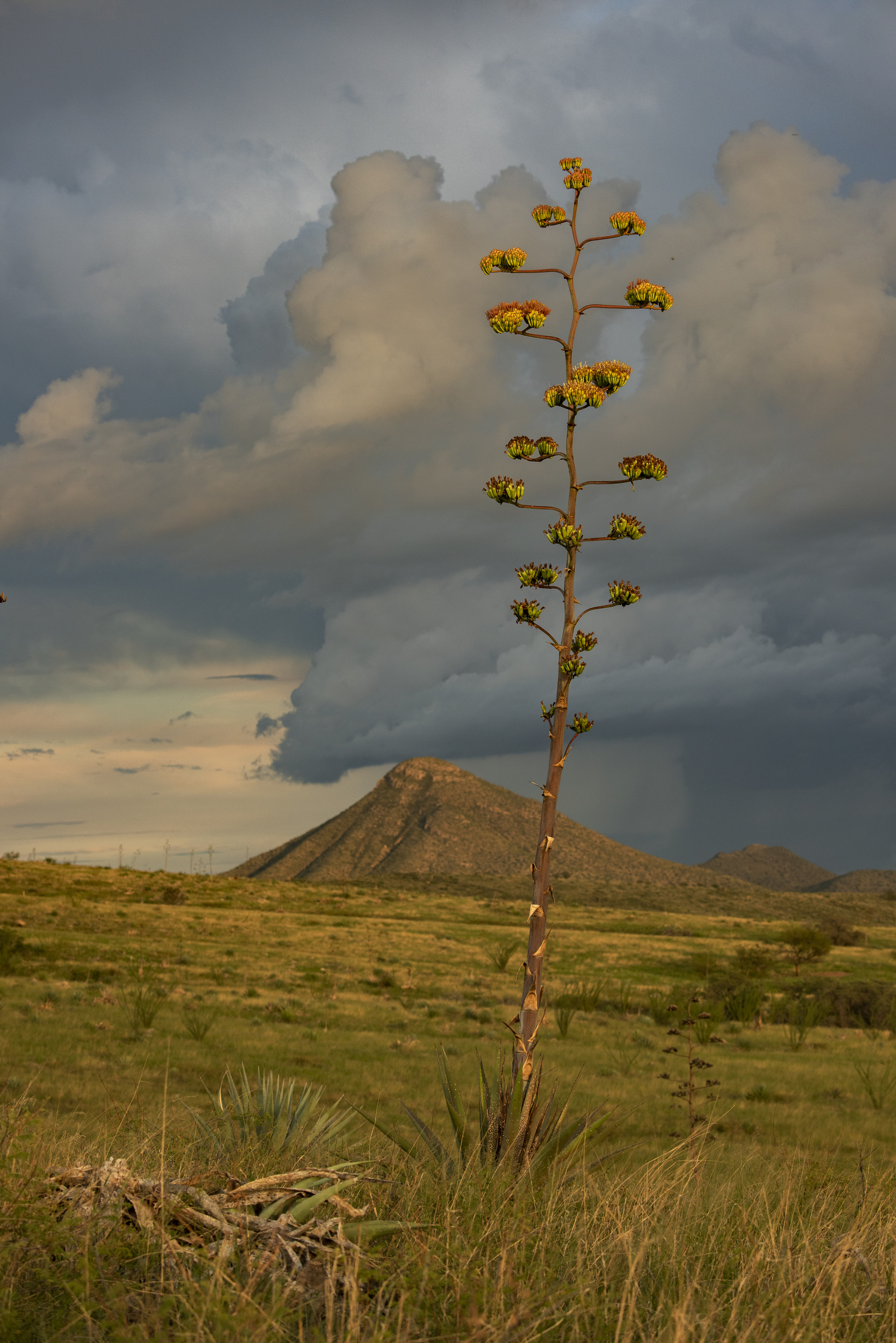
Borderlands agave. Photo by Bill Hatcher.

Agave makes a bold statement in drought-tolerant native landscaping. Towering panicles of blooming flowers attract a host of native insects and are a critical staple for Mexican and lesser long-nosed bats. Clusters of blooming agave also tell a story about community, culture and sustainability. Agave is part of the cultural identity for many communities. Agave is part of the cultural identity for many communities. For many traditional cultures, particularly in Mexico, agave is an important plant used for traditional drinks and food, local fibers, erosion control, pasture fencing and forage for cattle, particularly in dry years.

Nectar corridor restoration can be used to meet a whole variety of business goals while also benefiting nectar bats and local communities with cultural ties to agave. They are one strategy for private companies to challenge themselves to think differently about how to reimagine their corporate campus, transform and restore remediation sites, and prioritize STEM education. The private sector can also play a critical role in the recovery and protection of endangered species by planting agave to enhance habitat connectivity for pollinators like Mexican and lesser long-nosed bats.

View the on-demand webinar – Bats and Agave: Nectar Corridors and Cultural Connections in the Southwest – to learn more through about this opportunity to pursue WHC Conservation Certification through a collaboration with Bat Conservation International to protect migratory nectar bats by planting agave.

Join us and save bats by planting agave – we need you!

Mylea Bayless leads Bat Conservation International’s newly developed Network & Partnerships Division with over 20 years of experience in building collaborative teams for conservation, research, and wildlife management. Bayless joined BCI in 2006, with a career portfolio including State and Federal agency service and Academic research. Including bats, her research background includes a variety of wildlife (including spotted owls, bald eagles, American pronghorn, Merriam’s turkeys, and Rocky Mountain elk). She holds degrees from Colorado State University (B.S., M.S.).

https://tandemglobal.org/wp-content/uploads/2019/06/107154-19-scaled.jpg 1646 2048 Mylea Bayless https://tandemglobal.org/wp-content/uploads/2025/02/tandem-global-logo-exp.svg Mylea Bayless2019-06-05 09:48:422023-11-13 12:29:26Guest Blog: Save a Bat, Plant an Agave

Let’s Go Outside! The Benefits of Learning in the Outdoors

February 19, 2019/by Colleen Beaty

Like most kids, I loved to play outside when I was young. The great outdoors seemed to be filled with limitless potential for exploration and fun, and its ever-changing nature with the weather and turning of the seasons only seemed to expand the possibilities. I could find an adventure or feed my curiosity anywhere from the creek that ran through our neighborhood park to the underside of the yew hedge in my own front yard.

As educators, we can harness kids’ natural enthusiasm for being outdoors with engaging, hands-on lessons based in our local habitat. Being outdoors with plenty of room to explore and play provides kids with an outlet for their energy that indoor classroom settings just do not allow. There are many educational games that are designed to be physically active, like Project WILD’s Oh Deer!  This activity offers kids (and willing adults, too) with an opportunity to run around and play while simultaneously learning about the relationships between deer, plants and predators.

The seemingly endless potential of the outdoor environment also naturally lends itself to inquisitiveness, inspiring kids to ask questions and seek answers about what they see, hear, smell, and touch.

Exposure to nature from a young age, particularly repeated exposure, instills kids with an appreciation of nature and a desire to protect it, turning young children into natural conservationists as they grow up. Providing them with opportunities to participate in conservation activities, from planting trees to helping with wildlife monitoring, further instills a conservation ethic in kids by allowing them to see conservation “in action.” Is it any wonder, then, that after years of exploring the natural world as a kid, I grew up to work in conservation, as did so many of my peers?

If you would like to learn more about using the outdoors as a space for conservation education at your facility, check out our webinars  on conservation education such as Incorporating Project Learning Tree into Your Educational Projects and Measuring the Success of Your Conservation Education Projects, or email our Strategy and Planning team.

Read more WHC blogs.

https://tandemglobal.org/wp-content/uploads/2019/02/P_students-on-Leaf-River_GP-scaled.jpg 1365 2048 Colleen Beaty https://tandemglobal.org/wp-content/uploads/2025/02/tandem-global-logo-exp.svg Colleen Beaty2019-02-19 12:02:032023-11-28 09:59:39Let’s Go Outside! The Benefits of Learning in the Outdoors

A Magic Wand for Sustainable Improvements? The Tax Cut and Jobs Act as a Conservation Support – A Conservation Conference Recap

February 4, 2019/by Laurie Davies Adams

At the heart of our mission, WHC empowers companies to manage habitat on their lands. One of the ways in which we do so is though the sharing of technical knowledge and strategic advice, enabling businesses make the right decisions for their company, employees and the communities they work in.

At the 2018 Conservation Conference, Laurie Davies Adams, President and CEO Emeritus of the Pollinator Partnership and WHC Board Member presented a look at the new Tax Act and how it can correlate with conservation activities. The following is Laurie’s narrative of her presentation.

As 2019 starts, it can be tempting to retreat from environmentally sustainable actions as, amid the various swings in the news cycle, the environment can take a back seat to other headline-stealing stories.  Fear not! The world of sustainability is the future, and that future begins right now at the beginning of 2019. Smart and forward-thinking environmentally-conscious individuals and corporations will take advantage of every opportunity to build a more sustainable and profitable future – and 2019 has some unique and vital prospects through the Tax Cut and Jobs Act (TCJA), passed in 2017.

The new tax climate in the U.S. affords the chance to make a real difference now and in the future.  Never thought of the TCJA as a conservation law? Of course, it wasn’t the original intent, but there are many ways to look at the law, and it provides a couple of chances to finance conservation measures at a considerable savings.

Let’s start with the most obvious result of the TCJA – the corporate tax rate overall has fallen from 35% to 21% in most cases. This brings new fluidity to the cash flows of major corporations. Couple this with the ability to take a 100% depreciation deduction starting at the beginning of an acquisition, and cash flows improve even more. What to do with this extra cash? Obvious actions have included buying back stock, adding workers and improving wages, but one significant new prospect is to invest in long-term sustainability through capital improvements that will pay itself back in lowered operating costs and a reduced carbon footprint.

What could this mean for the economics of corporate operations? Solar panels reduce energy costs; native landscaping reduces water and maintenance costs; advanced pollution controls reduce the carbon footprint, promote compliance with carbon reduction goals and preserve the environment for employees, customers and the communities in which we operate.  The extra cash, adjusted depreciation and improved cash flow afforded by the Tax Cut and Jobs Act make projects that heretofore did not pencil out now make economic sense in both the short and long term.

The TCJA has another distinct advantage that conservationists can capitalize on, and here is where things get interesting – Opportunity Zones or, as I like to say, “A Trip to Oz.”  A Qualified Opportunity Zone (QOZ) is an economically-distressed community where new investments in a Qualified Opportunity Fund (QOF), under certain conditions, may be eligible for preferential tax treatment. QOFs invest in designated Opportunity Zones – census tracts identified by each governor in early 2018 and approved by the Department of the Treasury. These census tracts make up nearly 12% of the U.S. and have the lowest median income in each state – hence, they are areas ripe for capital investment and job creation. The Tax Cut and Jobs Act rewards investors who invest in Opportunity Zones in three distinct ways:

  1. Realized capital gain from any previous transaction that is invested in a QOF automatically gets a deferment on capital gains tax. The investment must be made within a certain time period and the tax still needs to be paid, but it can be deferred by remaining in an QOF invested in capital improvement in the Opportunity Zone. This deferment gives the investor latitude to invest that tax money in other projects immediately. This can mean up to a 72% increase in the overall cash flow as a result.
  1. If the realized capital gain is held in the QOF for 7 years, the tax will come due, but at a rate 15% lower than it would have been originally. It is, in essence, a free pass for 15% of the tax, allowing more available capital to be places in projects.
  1. If the money is held in the QOF investment for 10 years and invested in a capital improvements within the Opportunity Zone, you can sell the project/property/investment, and any gain on the transaction can be tax free. That makes it even more attractive to add improvements like modern HVAC and insulation, pollution controls and more environmentally and economically savvy improvements. These improvements will pay off as you operate the business and though they improve the property, when you sell it after 10 years, there is no tax on the gain that these improvements have wrought.

As with any capital investments, these opportunities warrant a coordinated effort among the real estate, sustainability and finance heads of any corporation, and since the regulations governing these investments are very complicated, it is essential to consult a tax professional to ensure compliance and maximum benefit. Though the rules are complex, the opportunity inherent in the Opportunity Zone is significant – AND, it offers more than a simple real estate development would; it gives the chance to make 21st century decisions about sustainability that will pay off in multiple ways – especially around sustainable improvements that may not have made sense under the old system.

Qualified Opportunity Funds are a unique opportunity to develop a sustainable project from the ground up in communities that will benefit the most – with an extra boost from the federal government. While conservation was never mentioned in the TCJA, it is also not prohibited by the structure of the Act – and it is an opportunity that even the Wizard of Oz couldn’t have cooked up as a means to take care of business while taking good care of our “No place like home,” planet earth.

Read more WHC blogs.

Wildlife Habitat Council does not provide tax, legal or accounting advice. This material has been prepared for informational purposes only, and is not intended to provide, and should not be relied on for, tax, legal or accounting advice. You should consult your own tax, legal and accounting advisors before engaging in any transaction.

https://tandemglobal.org/wp-content/uploads/2019/02/44470065710_6197f06b75_o.jpg 934 1851 Laurie Davies Adams https://tandemglobal.org/wp-content/uploads/2025/02/tandem-global-logo-exp.svg Laurie Davies Adams2019-02-04 16:20:202023-11-28 10:00:06A Magic Wand for Sustainable Improvements? The Tax Cut and Jobs Act as a Conservation Support – A Conservation Conference Recap

Bats, Birds and Owls – A Conservation Conference Session Recap

January 23, 2019/by Colleen Beaty

One of the more popular breakout sessions at the 2018 Conservation Conference, Bats, Birds and Owls: Capturing Community Interest Through Species Management Programs, focused on the use of species projects as a pathway for community engagement. Presenters from Freeport-McMoRan and Waste Management shared their stories about using the preservation and management of an iconic local species to create a positive narrative around conservation and industry.

Sean Wenham, Community Development Manager for Freeport-McMoRan, kicked off the session with an introduction to Freeport’s efforts to enhance burrowing owl habitat at its facility in Safford, Arizona. Community outreach and educational events with groups such as Wild at Heart have been integral in this project’s continuing success. Freeport won the 2016 WHC Avian Project Award for these efforts and continues to work closely with its partners to involve the community in learning about and creating habitat for this species.

Sean’s colleagues Emily Muteb, Development Manager, and Leah Sunna, Environmental Scientist, at Freeport’s Morenci Mine, also located in Arizona, discussed how their facility protects and monitors bats in the Eagle Creek Bat Cave and engages local schools in education about bats. This cave is an important maternity colony for over 1.8 million Mexican free-tailed bats.

Chelsea Adams, Assistant Principal for the Morenci Unified School District, also joined in the discussion, providing a school administrator’s perspective of these outreach events. Chelsea explained how companies and schools can most effectively work together to provide an engaging educational experience that meets both the company’s goals and the school’s academic standards, noting the importance of identifying your goals, planning and preparation, and allowing cross-pollination of concepts that can complement the learning experience. She also described how Freeport uses bat and bee mascots to ignite kids’ imaginations and get them excited about native species; this same bee mascot later surprised Conference attendees with an appearance at the Dinner and Awards Presentation.

Adriene Fors finished off the session by discussing the American kestrel banding project at Waste Management’s Grand Central Landfill in Pennsylvania. Bird banding is a valuable tool that allows you to track changes in bird populations and behavior/movement patterns, and is a fantastic way to engage the community. Adriene described how the facility built community interest in the project over time, using tools like social media and inviting the community to bird banding events.

Read more WHC blogs.

https://tandemglobal.org/wp-content/uploads/2017/10/FCX_Tech-Ctr_2016_30th.jpg 1500 1000 Colleen Beaty https://tandemglobal.org/wp-content/uploads/2025/02/tandem-global-logo-exp.svg Colleen Beaty2019-01-23 12:31:502023-11-28 10:00:33Bats, Birds and Owls – A Conservation Conference Session Recap

Looking Forward: The Next 30 Years of Corporate Conservation – A Conservation Conference Recap

January 8, 2019/by Patricia Leidemer

In 2018, WHC celebrated 30 years of experience at the intersection of conservation and business. We delved into our past accomplishments and celebrated the progress we’ve made. But always looking forward we ask ourselves, What does the next 30 years look like? What is the future of corporate conservation? At the 2018 WHC Conservation Conference we gathered thought leaders from Covia, Toyota and Ontario Power Generation (OPG) to lead a discussion on the emerging economic and environmental challenges and trends that will affect corporate conservation and drive change in the future.

Heather Ferguson, VP, Electrification Development at OPG, spoke about how utility companies and their customers will play a key role in the fight against climate change. Since climate change is the “most serious global threat to habitats and species,” transitioning energy use to clean electricity is crucial to mitigating the effects of climate change and biodiversity loss. She also discussed how the “electricity consumer of the future could become an energy prosumer.” Rather than simply consuming energy, consumers would become prosumers, becoming advocates for a wide-range of energy-efficient products and brands – from smart devices and connected appliances to solar panels and smart meters – and influencing how utilities such as OPG operate.

In a presentation titled “What is the Future for Mobility, Mr. George Jetson?”, Kevin Butt, General Manager and Environmental Sustainability Director at Toyota Motor North America, focused on the future of vehicles and mass transit, highlighting the importance of the consumer and how consumers have driven significant changes in the automobile industry. In many ways Kevin’s presentation echoed Heather’s in that consumers are becoming prosumers, increasing their demand for electric vehicles and mass transit.

Finally, Campbell Jones, EVP and Chief Operating Officer of Covia, discussed the future of mining, specifically how Covia “mines today, for tomorrow”. Focusing on forecasted trends such as an increase in energy consumption, the need for more water, energy, food, etc. with less resources, and the every-growing global population, Campbell emphasized how Covia operates with the future in mind. In its mining operations, Covia follows the mantra of “Respect, Replace, Renew,” where it respects the land within its care, replaces what is removed, and renews for a sustainable future, all the while continuing its commitment to people, planet and prosperity.

Learn more about our members ongoing commitment to biodiversity at:
https://www.toyota.com/usa/environment/
https://tandemglobal.org/success-stories/toyota-motor-engineering/
https://www.opg.com/about/environment/Pages/environment.aspx
https://unimin.com/sustainable/
https://tandemglobal.org/success-stories/covia/

Read more WHC blogs.

https://tandemglobal.org/wp-content/uploads/2019/01/Next-30-Years.png 500 800 Patricia Leidemer https://tandemglobal.org/wp-content/uploads/2025/02/tandem-global-logo-exp.svg Patricia Leidemer2019-01-08 11:38:142023-11-28 11:15:47Looking Forward: The Next 30 Years of Corporate Conservation – A Conservation Conference Recap

Corporations Recognized for Conservation Excellence at 2018 WHC Awards

November 20, 2018/by Monica Keller

SILVER SPRING, MD, NOVEMBER 19, 2018 – Wildlife Habitat Council (WHC) announced the winners of its 2018 WHC Awards at the WHC Conservation Conference, held November 13-14 in Baltimore. The WHC Awards honor excellence in corporate conservation; recipients include both national and international companies across a variety of industry sectors. This year’s top awards, signifying leadership in conservation, were won by DTE Energy, Exelon and General Motors (GM).

“Recognizing corporate conservation is at the heart of our organization, and it is exemplified by the work of DTE Energy, Exelon, GM, and all of our award winners,” said Margaret O’Gorman, President, WHC. “These outstanding projects and programs are prime examples of the positive influence and impact that corporate conservation can have on biodiversity, local communities and employees.”

DTE Energy received the 2018 Corporate Conservation Leadership Award. The Corporate Conservation Leadership Award honors one company’s overall achievement in conservation efforts and signifies an exemplary level of corporate commitment to biodiversity and conservation education, and meaningful alignments with global conservation objectives.

The Employee Engagement Award, given to Exelon, recognizes a company’s involvement in conservation through the sheer force of its employee teams who participate in its habitat and conservation education activities. Exelon also received the following Project Awards: Bats Project Award (Exelon Criterion Wind); Integrated Vegetation Management Award (Exelon, PECO Conservation Rights-of-Way); and Land Conservation Agreements Award (Exelon Criterion Wind).

GM received the 2018 Gold Tier Program Award for its conservation efforts at the GM Canada CAMI Assembly Plant in Ontario, Canada. GM was also awarded the Deserts Project Award for its work at the GM San Luis Potosí Complex near Mexico City.

The Gold Program Award honors the overall conservation depth of one exceptional program. Projects are recognized for excellence in each of the WHC Project Guidance themes. This category offers projects of all sizes the ability to compete for recognition. Learn more about the Project Award criteria at here.

The following is a complete list of 2018 Project Award winners:

  • Avian Project Award: Vulcan Materials, Grandin Sand Plant
  • Awareness and Community Engagement Project Award: Bayer, Camaçari Plant
  • Bats Project Award: Exelon, Criterion Wind
  • Caves and Subterranean Habitats Project Award: Covia, Hager City/Bay City
  • Desert Project Award: General Motors, San Luis Potosí Complex
  • Forest Project Award: Boeing, South Carolina – Keystone/Fairlawn Project
  • Formal Learning Project Award: Bayer, Muscatine Plant and Big Sand Mound Nature Preserve
  • Grasslands Project Award: Marathon Petroleum, Palestine Neal Pit
  • Green Infrastructure Project Award: ITC Holdings, Iowa City Warehouse
  • IVM Project Award: Exelon, PECO Conservation Rights-of-Way
  • Invasive Species Project Award: Freeport-McMoRan, Henderson Operations
  • Invasive Species Coordinated Approaches Project Award: Waste Management, Varick I Transfer Station
  • Land Conservation Agreements Project Award: Exelon, Criterion Wind
  • Landscaping Project Award: Republic Services, Charlotte Motor Speedway Landfill
  • Mammals Project Award: Freeport-McMoRan, Morenci Mine
  • Marine Intertidal Project Award: Boeing, Boeing Plant 2
  • Other Habitats Project Award: Vulcan Materials, Cajon Creek Habitat Conservation Area
  • Other Species Project Award: Boeing, Santa Susana Field Laboratory
  • Pollinator Project Award: BASF Rensselaer Environmental Education Classroom & Ecology Center
  • Remediation Project Award: Boeing, Santa Susana Field Laboratory
  • Reptiles and Amphibians Project Award: CEMEX, Las Salinas & Laguna Cabral
  • Species of Concern Project Award: Covia, Hager City/Bay City
  • Training Project Award: ITC Holdings, ITC Transmission Right-of-Way at Tomlinson Arboretum
  • Wetlands Project Award: OPG, Eastern Operations Hydro

Award finalists and winners were chosen from Conservation Certification applications submitted from January 1, 2018 – July 15, 2018 that were granted certification. Applications received after July 15, 2018 and applications what were in the appeals process in 2018 will be considered for the 2019 WHC Awards. Information on award criteria can be found here.

About Wildlife Habitat Council

Wildlife Habitat Council partners with corporations, fellow conservation organizations, government agencies and community members to empower and recognize wildlife habitat and conservation education programs. Our members are environmental leaders at local, national and global levels, voluntarily managing their lands to support sustainable ecosystems and the communities that surround them. Since 1988, WHC has certified more than 1,000 habitat and education programs worldwide; WHC Conservation Certification programs can be found in 48 states and 25 countries. To learn more, visit www.wildlifehc.org or follow @WildlifeHC on Twitter.

For More Information

Monica Keller  |  Wildlife Habitat Council  |  240.247.0930

https://tandemglobal.org/wp-content/uploads/2018/11/IMG_8439-scaled.jpg 1365 2048 Monica Keller https://tandemglobal.org/wp-content/uploads/2025/02/tandem-global-logo-exp.svg Monica Keller2018-11-20 11:48:432023-07-16 16:37:24Corporations Recognized for Conservation Excellence at 2018 WHC Awards

The Importance of Aligning Your Projects with Learning Standards

August 16, 2018/by Colleen Beaty

WHC Conservation Certification requires that formal learning projects be aligned with learning standards. But what exactly are learning standards, and why are they important?

Learning standards, also called academic standards, are the standardized benchmarks of quality and excellence in education. The standards for grades K-12 are typically set by the government agency responsible for education, or in some cases are set directly by the school. Undergraduate- and graduate-level classes will also have standards set by the school or professor. Learning standards lay out expectations for the specific information and skills students at each grade level should learn, ensuring that the topics, skills, and rigor for each grade level are age-appropriate.

Learning standards function as goals. They differ from the teacher’s curriculum, which is a detailed plan for day-to-day teaching with specific information about topics, activities, and exams and is designed to meet the goals set by the learning standards for the applicable subject and grade level.

When you align your conservation education activities with learning standards, you are helping ensure that your activities are focusing on the knowledge and skills deemed essential for learners at your audience’s grade level.

Aligning your team’s educational activities with learning standards makes the activities more attractive to teachers and school administrators, who may not want to take time away from classroom activities that are needed to meet standards. Supporting state standards with conservation education activities also provides teachers with a way to engage learners in hands-on, minds-on learning that meets their objectives, and provides students with an outdoor setting where they can gain and practice newfound knowledge and skills.

The best way to ensure your conservation education activities align with learning standards is to coordinate directly with the teachers who will be bringing their students to your site. Working with teachers to develop outdoor, hands-on lessons will help you ensure that those lessons are relevant to what students are learning in the classroom and help meet learning standards. This helps demonstrate to teachers, parents, and school administrators the value of your site’s relationship with the school.

To learn more about the requirements and recommendations for formal learning projects, be sure to read our Formal Learning Project Guidance, or contact strategyandplanning@wildlifehc.org.

Read more WHC blogs.

https://tandemglobal.org/wp-content/uploads/2017/10/P_kids_wetland_Bruce-Power_30th-scaled.jpg 1360 2048 Colleen Beaty https://tandemglobal.org/wp-content/uploads/2025/02/tandem-global-logo-exp.svg Colleen Beaty2018-08-16 12:32:502023-11-28 10:01:23The Importance of Aligning Your Projects with Learning Standards

What We Learned by Building Insect Hotels

June 19, 2018/by Colleen Beaty

Earlier this month at our annual staff retreat, my fellow WHC colleagues and I stepped into our members’ shoes for an afternoon and built our own insect hotels. The process of designing and assembling our insect hotels was a fun, hands-on learning experience for all of us.

For some of us it was an introduction to insect hotel hotels, and we all found out more about the kinds of features you can incorporate to benefit native bees and other beneficial insects. The array of natural and manmade materials we had available also inspired us to get creative with our designs.

Our finished hotels included wooden blocks and logs with drilled holes, bundles of reeds and paper tubes where solitary can lay their eggs in the holes and then seal up the entrance with mud or leaf litter. We also added other dried plant material such as twigs, dried leaves, dried grasses, moss, seed pods and pinecones, where other beneficial insects like ladybugs, ground beetles, lacewings and hoverflies—all important predators of pest insects—will seek cover. In addition, some of the structures included materials like bricks and slabs of dark slate, which will warm up in the sun and provide basking areas for insects.

This exercise led to some fantastic insights about how to make insect hotels a successful part of your corporate conservation program, and we wanted to share these insights to help you with building one for your site:

  • Insect hotels are a great team-building exercise. They allow team members to work together on a project, while also providing an opportunity to use their specific talents to create a better final product. Some folks may have a knack for creating an attractive or imaginative design, for example, while others may feel better equipped for more hands-on activities like constructing the frame for the structure.
  • It is really helpful to decide ahead of time what species you want to attract or what species in your area might benefit from an insect hotel, so that you don’t waste time constructing features or gathering materials that need to be changed or don’t end up getting used.
  • In a similar vein, determine how the structure will be installed, mounted or hung before laying out the design, rather than figuring it out as an afterthought and potentially having to jury-rig the installation.
  • Leftover materials need not got to waste – employees can use them to make their own insect hotel back at home.
  • Bigger is not necessarily better. For those new to the planning and construction of insect hotels, it might actually be easier to take on smaller structures.
  • You can add whimsical or artistic features or use a story about the kinds of bugs that visit the hotel to elicit the imagination of learners, especially young children, and help them better remember the experience.

If you want to learn more about how to build your own insect hotel, watch our webinar from earlier this year, Build a Bug Palace. And when you do build your own insect hotel, be sure to enter our “Best Of” Insect Hotel contest by August 1, 2018. We’ll be announcing the winners of the challenge at this year’s Conservation Conference, where you’ll also have a chance to see our staff’s insect hotels in person.

Read more WHC blogs.

https://tandemglobal.org/wp-content/uploads/2018/06/WL_bee-in-insect-hotel_AdobeStock_200895188-scaled.jpeg 1367 2048 Colleen Beaty https://tandemglobal.org/wp-content/uploads/2025/02/tandem-global-logo-exp.svg Colleen Beaty2018-06-19 09:50:192023-11-28 10:02:15What We Learned by Building Insect Hotels

Opel Vauxhall Has Become the Engine of Change in Europe

February 14, 2018/by Ivonne Rodriguez

In the northeast region of Spain, there is a small city called Zaragoza, where Opel Vauxhall, a leading vehicle manufacturing company, has become the engine of change in Europe.

Idoia Espinal, an environmental engineer at Opel Vauxhall, explained the impact that Opel and its sustainability goals have brought to this city. “Whether it be the community of Zaragoza or our employees themselves, we’ve made sure everyone who visits the site knows how important it is all the work we are doing and how it is helping the environment.”

With over 700,000 acres and more than 5,000 employees and contractors, Opel Vauxhall has been able to demonstrate that beyond building and selling vehicles that reduce emissions of compounds such as carbon emissions, it also takes care of its flora and fauna.

Upon entering the site, one can experience how much the company cares about the environment. Built right on the entrance of the parking lot there is a natural fence of native plant and flower species that withstand the cooler climate of northeastern Spain, who were chosen mainly for their representation of the Spanish culture and their biodiversity value. The site is open to the public throughout most of the year.

Currently, the largest project the site has is its xeriscaping garden – a style of gardening that advocates for the use of native climate-adapted species, resulting in low water use and a reduced need for fertilizer application and other maintenance. These measures have created opportunities for pollinators like bees and butterflies to create a home in Opel Vauxhall.

The company also maintains a grove of ​​native trees near its water plant. This area is designed according to the same xeriscaping guidelines, and the trees provide an oasis of vegetation for bird and insect species in Zaragoza.

These projects are maintained and monitored by employees of the company, who have gradually learned how to carry out the same strategies in their home landscapes.

With much enthusiasm, Espinal tells us that thanks to the performance of Opel Vauxhall in Zaragoza, many other manufacturing plants have also been inspired to follow their same steps, “There is more sensitivity towards the issue, both from employees and other manufacturing plants. You have to set the example, and whatever is feasible for them to follow, then they should follow.”

Espinal summed up the program’s intended impact by noting, “As stated before, we must be the engine of change, and now the community and our workers have come together to be ambassadors of this positive change.”

Read more WHC blogs.

https://tandemglobal.org/wp-content/uploads/2018/02/White-poplars-scaled.jpg 1536 2048 Ivonne Rodriguez https://tandemglobal.org/wp-content/uploads/2025/02/tandem-global-logo-exp.svg Ivonne Rodriguez2018-02-14 10:47:392023-11-28 10:02:47Opel Vauxhall Has Become the Engine of Change in Europe
Page 5 of 10«‹34567›»

Pages

  • 2015 WHC Award Winners and Finalists
  • 2016 WHC Award Winners and Nominees
  • 2017 WHC Award Winners and Finalists
  • 2018 WHC Award Winners and Finalists
  • 2019 WHC Award Winners and Finalists
  • 2020 WHC Award Winners and Finalists
  • 2021 WHC Awards Winners and Finalists
  • 2022 WHC Awards Winners and Finalists
  • 2023 WHC Awards Winners and Finalists
  • 2024 Awards Dinner Menu
  • 2024 WHC Awards Winners and Finalists
  • 2025 Tandem Global Awards Winners and Finalists
  • Become a white paper sponsor
  • Brand Guidance for Members and Partners
  • Certification
  • Certification Support Center
  • Climate Action Works
  • Conference Draft
  • Conservation Conference 2024 Agenda
  • Conservation Conference 2024 Exhibitor Form
  • Conservation Conference 2024 Exhibitors
  • Conservation Conference 2024 Travel Information
  • Consulting – From Old Site (Delete later)
  • Corporate Member Complimentary Consulting Support Questionnaire
  • EAC Confirmation
  • Earth Day and World Environment Day Events
  • Earth Day Planting Event
  • Events
  • Executive Thought Leadership Events
  • Five Star and Urban Waters Restoration Grant Program
  • Get Involved
  • Home
  • Industry News
  • Nature Steward Alliance
  • Nature-based Solutions for Pollution Prevention
  • Nesting Structure Challenge
  • New to Certification?
  • News & Insights
  • Official Signage
  • Our Brand
  • Our Brand (copy)
  • Our Network
  • Our Origin Short Story
  • Payment Center and Donations
  • Payment Confirmation
  • Payment Failed
  • Planting Event Registration | October 18
  • Planting Event Registration | October 25
  • Pollinators
  • PR Materials for Certified Programs
  • Privacy Policy
  • Project Guidances
  • Project Guidances Overview
  • Registration Information
  • Reports and Toolkits
  • Saving Bats from Decline
  • Social Impact
  • Spirit Award
  • Sponsor Events, Content and Programming
  • Sponsor Interest Form
  • Sponsor webinars
  • SS Project
  • SS Search Results
  • Student Scholarship Application
  • Style Guide
  • Subscribe
  • Tandem Global Awards Dinner Program and Menu
  • Tandem Global Conference 2025 Agenda
  • Tandem Global Conference 2026 Agenda
  • Urban Forestry
  • WHC at COP16
  • WHC Project Guidances
  • Who We Are
  • About Certification
  • Application Overview
  • Attend an Event
  • Conservation Certification Versioning
  • Conservation Conference 2024
  • Consulting Services
  • Executive Advisory Committee
  • External Review Process
  • Fees
  • From the CEO
  • Meet Our Members
  • Mission, Vision, Values
  • Monitoring Templates
  • Navigation Tips
  • Overview of Requirements
  • Privacy and Security Policies
  • Project Types
  • Recognition
  • Social Impact
  • Tandem Global Conference 2025
  • Tandem Global Conference 2026
  • Thought Leadership
  • What is WHC Certification?
  • WHC Index
  • Awards
  • Awards and Recognition
  • Blog
  • Careers
  • COVID-19 Accommodations
  • Create an Account
  • Determining Your Project Types
  • Generating an Invoice
  • Habitat Project Requirements
  • Habitat Species Inventories
  • How Your Application is Evaluated
  • Issue-Based Initiatives
  • Key Considerations for Applying
  • Member Spotlight
  • Stakeholder Input
  • Understanding Project Types
  • Webinars
  • What It Means to Be Certified
  • White Papers
  • Become a Member
  • Contact
  • Elevate Network
  • Informational Videos
  • Managing Your Account
  • Marketing Support
  • Our People
  • Paying Invoices
  • Point Values
  • Press
  • Renewal Applications
  • Species Project Requirements
  • Value of WHC Certification
  • WHC Awards
  • Working in the Certification Website
  • Deadlines
  • Education Project Requirements
  • How to Apply
  • Program Registration
  • Scoring Sheets
  • Site and Program Contacts – Start Here
  • Add People/Edit or Remove Permissions
  • Application Outcomes
  • Corporate Contacts – Start Here
  • Finalizing and Submitting Your Application
  • Other Options Project Requirements
  • Requirements
  • Adding, Editing and Deleting Projects
  • Appeals
  • Common Evaluation Criteria
  • Invoices and Payments
  • Application Forms
  • Habitat Project Evaluation Criteria
  • Review and Evaluation
  • Printing Your Application
  • Resources
  • Species Project Evaluation Criteria
  • Education Project Evaluation Criteria
  • Potential Error Messages
  • Recognition and Awards
  • Additional Assistance
  • Certification Standard
  • Other Options Project Evaluation Criteria
  • Policies
  • Status Dictionary

Categories

  • Avian
  • Awareness and Community Engagement
  • Bats
  • Caves and Subterranean
  • CEO Blog
  • Client Case Studies
  • Desert
  • Education & Awareness
  • Forest
  • Formal Learning
  • Grasslands
  • Green Infrastructure
  • Habitat
  • Integrated Vegetation Management
  • Invasive Species
  • Land Conservation Agreements
  • Landscaping
  • Mammals
  • Marine Intertidal
  • Member Spotlight
  • Other Options
  • Pollinators
  • Press Release
  • Remediation
  • Reports and Toolkits
  • Reptiles and Amphibians
  • Rocky Areas
  • Social Impact
  • Species Management
  • Species of Concern
  • Tandem Global Blog
  • Training
  • Uncategorized
  • Wetlands
  • White Paper

Archive

  • March 2026
  • February 2026
  • December 2025
  • November 2025
  • October 2025
  • September 2025
  • July 2025
  • June 2025
  • April 2025
  • March 2025
  • February 2025
  • January 2025
  • November 2024
  • October 2024
  • September 2024
  • August 2024
  • July 2024
  • June 2024
  • May 2024
  • April 2024
  • March 2024
  • February 2024
  • January 2024
  • December 2023
  • November 2023
  • October 2023
  • August 2023
  • July 2023
  • June 2023
  • May 2023
  • February 2023
  • January 2023
  • December 2022
  • November 2022
  • October 2022
  • September 2022
  • August 2022
  • July 2022
  • June 2022
  • March 2022
  • December 2021
  • November 2021
  • October 2021
  • August 2021
  • July 2021
  • June 2021
  • May 2021
  • April 2021
  • March 2021
  • February 2021
  • January 2021
  • December 2020
  • November 2020
  • October 2020
  • September 2020
  • August 2020
  • June 2020
  • May 2020
  • February 2020
  • January 2020
  • December 2019
  • November 2019
  • September 2019
  • July 2019
  • June 2019
  • May 2019
  • February 2019
  • January 2019
  • December 2018
  • November 2018
  • September 2018
  • August 2018
  • June 2018
  • May 2018
  • March 2018
  • February 2018
  • January 2018
  • November 2017
  • September 2017
  • August 2017
  • July 2017
  • June 2017
  • May 2017
  • April 2017
  • March 2017
  • February 2017
  • January 2017
  • December 2016
  • November 2016
  • October 2016
  • September 2016
  • August 2016
  • July 2016
  • June 2016
  • May 2016
  • April 2016
  • January 2016
  • December 2015
  • November 2015
  • October 2015
  • September 2015
  • August 2015
  • June 2015
  • May 2015
  • April 2015
  • February 2015
  • January 2015
  • December 2014
  • November 2014
  • October 2014
  • September 2014
  • July 2014
  • May 2014
  • April 2014
  • March 2014
  • February 2014
  • January 2012
  • June 2011
  • April 2011
About

About Tandem Global
Mission, Vision, Values
Our Brand
Our People
Careers
Contact

Our Network
Meet Our Members
Member Spotlights
Become a Member
Sponsorships

Financials and Policies
Privacy Policy

Work with Us

Consulting Services

Certification
About Certification
Awards and Recognition
Executive Advisory Committee
Official Signage
Log-in or Register
Support Center

Social Impact

Thought Leadership

Learn More

News & Insights
From the CEO
Blog
Industry News
Press

Resources
White Papers
Index of WHC-Certified Programs
Project Guidelines

Events
Tandem Global Conference 2025
Webinars
Executive Meetings
Elevate Network

Member

UN Global Compact
Business for Nature

Official ally

World Benchmarking Alliance

Subscribe for Updates
Payment Center

Connect with us on Linkedin

About

About Tandem Global
Mission, Vision, Values
Our Brand
Our People
Careers
Contact

Our Network
Meet Our Members
Member Spotlights
Become a Member
Sponsorships

Financials and Policies
Privacy Policy

Work With Us

Consulting Services

Certification
About Certification
Awards and Recognition
Executive Advisory Committee
Official Signage
Log-in or Register
Support Center

Social Impact

Thought Leadership

Learn More

News & Insights
From the CEO
Blog
Industry News
Press

Resources
White Papers
Index of WHC-Certified Programs
Project Guidelines

Events
Tandem Global Conference 2025
Webinars
Executive Meetings
Elevate Network

Member of UN Global Compact Business for Nature

Official Ally: World Benchmarking Alliance

Sign Up For Updates

Subscribe
Payment Center

Connect with us on Linkedin

Scroll to top Scroll to top Scroll to top